
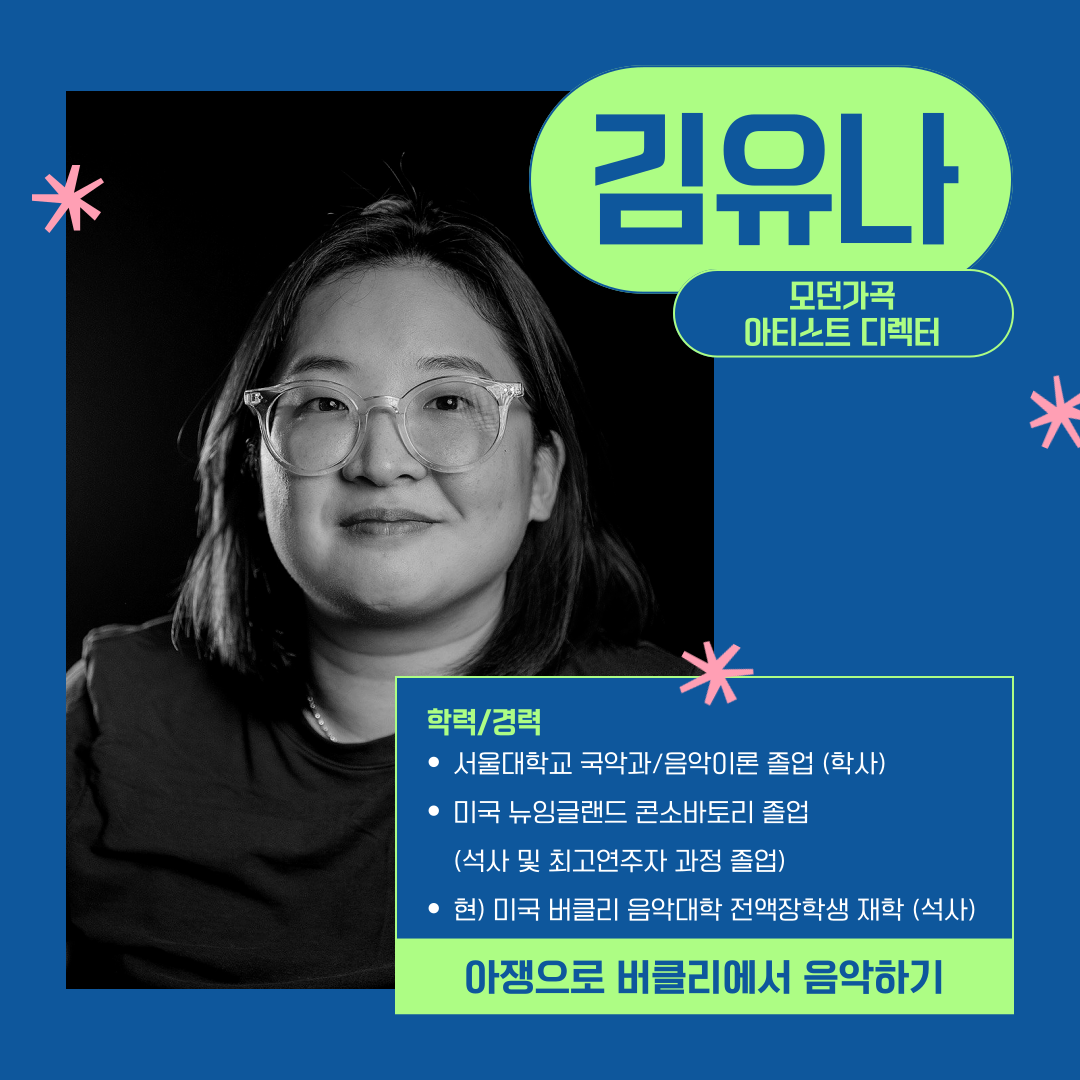
Yoona Kim - Ajaeng Performer / Artist Director of Modern Gagok
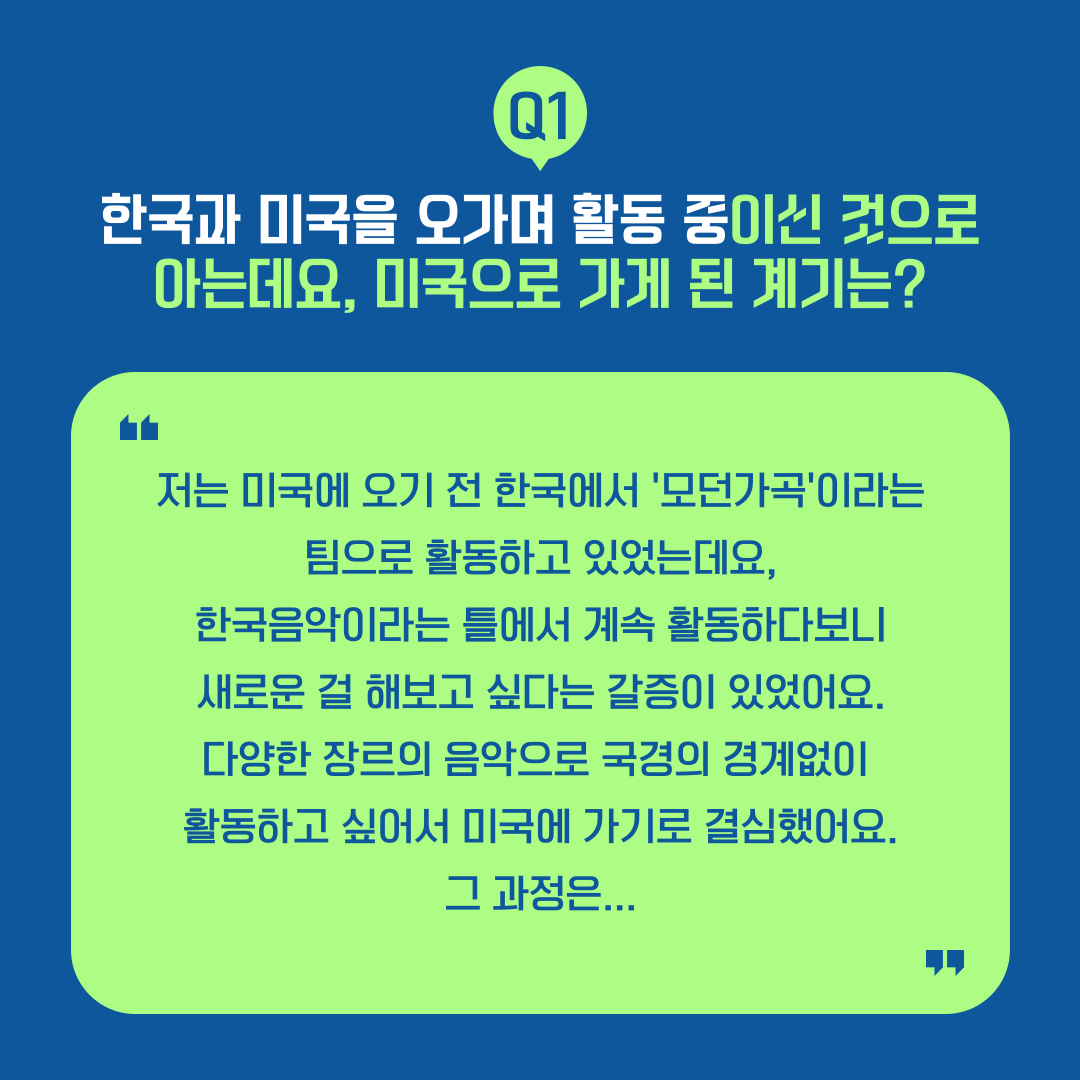

Hyunchae Kim: What led you to go abroad? I’m curious about your motivation.
Yoona Kim: Ever since entering university, I had a strong desire to make music that extended beyond traditional Korean music. So I kept looking for opportunities to go abroad. That’s when I joined a now-discontinued overseas student tour program run by the Korea Tourism Organization. We traveled around several European countries in a camper van and performed. Students from various majors—music, culinary arts, Taekwondo, tourism—were selected to promote Korean culture abroad. It was my first time creating a performance with friends and meeting people from other fields, and it became a very meaningful experience for me. Many of the participants also wanted to go abroad, so we exchanged information about how to prepare for studying overseas—that was helpful. Above all, although I loved Korean music and enjoyed studying it, something about it didn’t feel completely like “my own,” like clothes that fit me perfectly. I wanted to create something that was uniquely mine.
Hyunchae Kim: Before coming to the U.S., you had already been doing creative work with the group Modern Gagok, right?
Yoona Kim: Yes, through Modern Gagok I tried many things. I felt that while I was well trained as a performer, I wasn’t trained as an artist. The university curriculum reinforced that feeling. I wanted to be an artist who could create—someone who could express my own voice, not just a performer. Even if I stopped making music someday, I wanted to try making art. When I listened to jeongga, there were aspects I found deeply beautiful—things I wanted to interpret in my own way. That’s why I started Modern Gagok, and I think I did everything I possibly could in that setting. Through it, I was able to develop an independent artistic mindset. Beyond simply creating music, I learned entrepreneurial skills—making performance opportunities, considering the members, and more.
Even after coming to the U.S., I’ve continued the Modern Gagok work. Even if I leave Korea, I can continue the projects I started there; society has changed so that international collaboration is now possible from anywhere. Our second full-length album is coming out this year. I wrote all the pieces while in the U.S., and then last summer, when I visited Korea, I recorded with the members. These days, people abroad don’t stay only abroad, and people in Korea don’t stay only in Korea—artists in the U.S. also want to expand to Asia. The psychological distance has become much smaller. Wanting to go abroad means wanting to work globally—not just in one place. Many people travel the world while continuing their home-base projects. I think it’s about expanding the scope of one’s activities.
Hyunchae Kim: Before fully coming to the U.S. to study, did you have any experience with language study abroad or long-term stays?
Yoona Kim: Yes, I did a three-month language program. At the time, I was so shy and my English was so poor that I barely spoke. But in hindsight, it helped me adjust later when I came to study. Even simple things—how to activate a phone plan, use public transportation, which grocery stores sell which essentials—plus getting a sense of American culture beforehand helped so that even though I later studied in a different region, it didn’t feel so unfamiliar.
Hyunchae Kim: When you officially began studying abroad, what goals did you have?
Yoona Kim: Honestly, I came with the intention of not doing Korean traditional music. Since my environment had changed, I wanted to focus on the opportunities given here. I came to study, so I thought, “Let’s do what I’ve never been able to do—let’s step out of my comfort zone!” Now my goals change almost daily. I don’t limit myself to one genre, so the music I like keeps changing. These days I love Korean music again. After learning other types of music and widening my knowledge, playing traditional music feels even better than before. Performing feels better, and I think my playing has improved too. I judge myself much more strictly than others do—I have my own standards, and they can be harsh. My playing now includes storytelling, and I can feel that when I perform.
Hyunchae Kim: At the New England Conservatory (NEC) you completed a master’s, and at Berklee you did another master’s. What were your majors at each school?
Yoona Kim: At NEC I completed a master’s and a Graduate Diploma in Contemporary Musical Arts, which used to be called Contemporary Improvisation. I studied a lot of performance and composition. In composition, I learned classical harmony and counterpoint, but the program focused more on contemporary composition. One difference from Korea is that although there is a general curriculum, you choose your own private teacher and design your two-year study plan yourself. One of the most helpful classes was “Development of Personal Style.” Two instructors taught it, each with their own approach. We studied many samples of other musicians’ works and then composed in our own style, discovering what we liked and disliked.
At Berklee, I did a one-year master’s in Global Jazz, completing three semesters. In the U.S., it’s impossible to avoid the influence of jazz on all arts, so I felt I needed a deeper understanding of it. Studying jazz more intensively broadened my understanding, and that gave me more freedom in both performance and composition.
Hyunchae Kim: I’m curious about the admissions process. What were the requirements and audition tasks?
Yoona Kim: It varies by school, but I prepared about three pieces: one original, one arrangement of an existing piece, etc. For Berklee, they gave a list of jazz pieces to choose from, plus blues, an original composition, and an arrangement. Since I had been composing with Modern Gagok, it wasn’t difficult. Because it was during COVID, there were no in-person auditions—everything was submitted by video, and ear-training tests were done via Zoom. There was also a faculty interview. Berklee’s interview was interesting—they emphasized social engagement, asking questions like, “How can you change the world through your music?”
Hyunchae Kim: What have you been doing since graduating? I’m curious about your performance repertoire too.
Yoona Kim: I have a lot of repertoire—details are on my website. I perform at the Museum of Fine Arts in Boston for Hanukkah events, presenting my work that combines Korean music with Jewish music. Here in the U.S., I’m part of a blues duo featuring banjo and ajaeng. I’m also in a country/old-time music group called the Global String Band Jool—we’re releasing an album in 2026. And I’m part of the Global Yiddish Orchestra, which combines ajaeng with klezmer. Each group has different musical colors and instrumentation. I’m also releasing a free-improvisation duo album with trumpet next year, both online and as a physical album.
Hyunchae Kim: You’ve already graduated. Why did you decide to stay in the U.S. instead of returning to Korea?
Yoona Kim: Personality-wise, the U.S. suits me better. Here, diversity is respected, and it feels more comfortable to express myself in that kind of culture. “A culture that respects differences”—that lifestyle fits me, and I feel familiar with the overall culture now.
Hyunchae Kim: What’s different about living as an artist in the U.S. versus in Korea?
Yoona Kim: I think it’s basically the same—you have to work hard to survive as an artist. The culture of respecting differences makes it seem different, but in terms of artistic work, it’s not that different. The main difference is whether there are people around you doing Korean traditional music or not. In Korea there are lots of unique, interesting artists, so the artistic work itself isn’t so different. But the U.S. has a bigger population and more diverse people, so if you’re seeking something new, the U.S. can be a better place.
Hyunchae Kim: Since leaving Korea, what has been your happiest memory and your most difficult one?
Yoona Kim: Probably receiving two awards at NEC’s graduation—the first time in the school’s history. The “Global Musician Award” is given to the best student in world instruments, and the “Tourjee Award” is a faculty-nominated award given to the most outstanding student in the entire school.
The hardest moments were definitely the experiences of racism you face as a foreigner. Strangers have tried to assault me on the street or thrown cans at me for no reason. Going from living as part of the majority in Korea to living as an Asian person in America… It was the moment when a social issue I had only seen on the news became reality.
Hyunchae Kim: Lastly, do you have any advice for younger students dreaming of studying abroad or working overseas?
Yoona Kim: Fighting! If there’s something you want to do, go for it without hesitation!
Hyunchae Kim: Gayageum performer / educator; Resident Artist at the Korean Performing Arts Center of Chicago (KPAC); Director of Stringway.
Yoona Kim: Ajaeng performer / Artistic Director of Modern Gagok. B.A. in Korean Traditional Music, Seoul National University; M.A., New England Conservatory; M.A. in Global Jazz, Berklee College of Music.
