
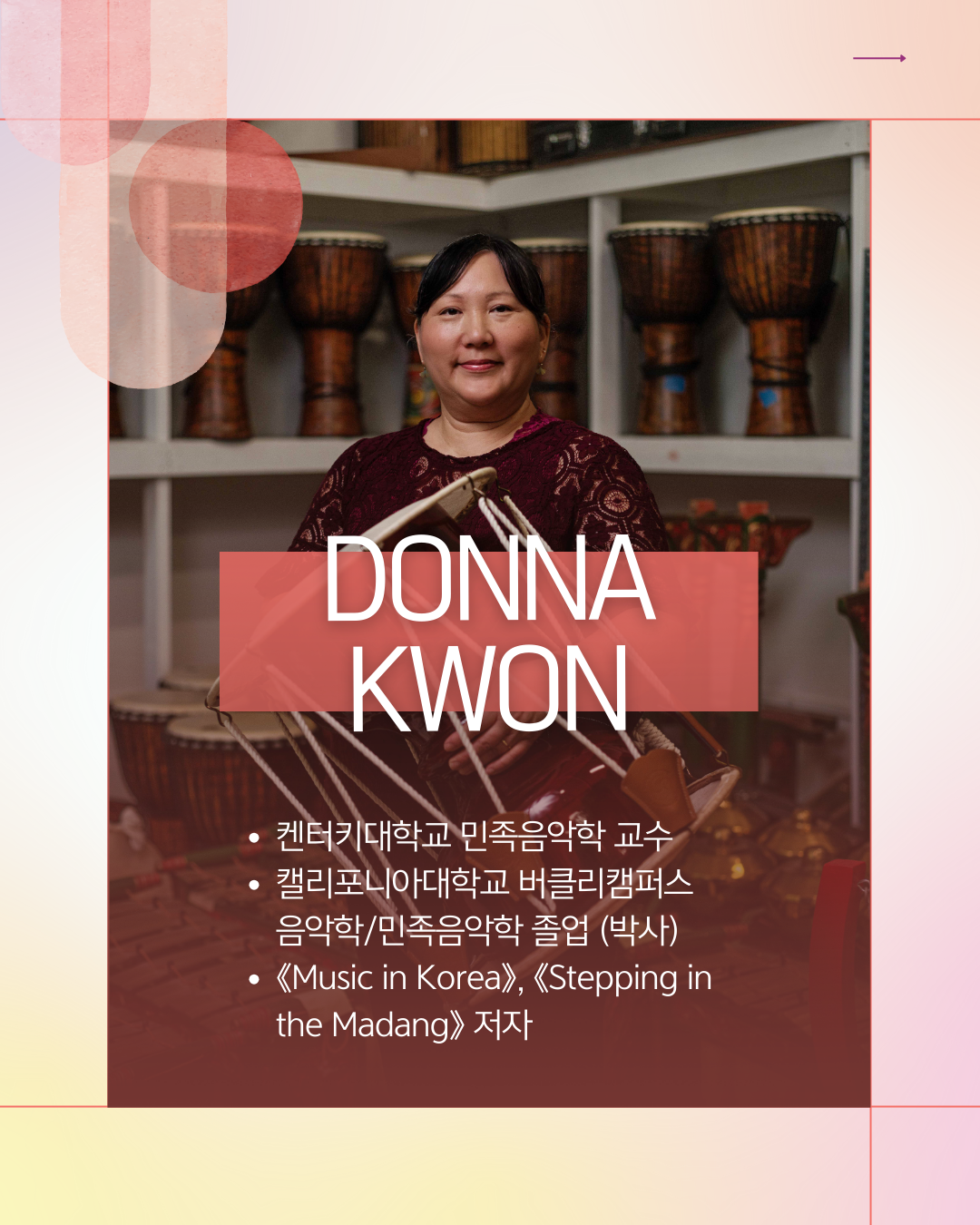
Donna Kwon - Professor of Ethnomusicology at the University of Kentucky

Gina Choi: What is your cultural identity and how important is it to you?
Donna Kwon: I identify as a Korean American. Sometimes I identify more as Korean, but then sometimes I just identify as an American citizen. And sometimes I also identify as an Asian American woman. Those are the main things, but I also identify as a musician and as a perpetual student and learner.
Gina: Do you feel like any one of those are any more important than the other?
Donna: I would say that I'm very deep into Korean culture right now, and I guess I always have been, but maybe it's because I've been watching so many K-dramas and listening to so much K-pop that that is pretty primary right now, I'm not gonna lie.
Gina: What is your background and what are your qualifications in Korean music?
Donna: I grew up performing Western music and playing piano, but I also learned clarinet in school and then I started going to the San Francisco Conservatory on Saturdays. There, I also was part of a choir, and that choir actually did well, and we performed at interesting venues like the Bach Festival. And then, I continued on at the Conservatory at Oberlin studying piano performance, but I also knew that I was starting to get interested in other things. I was definitely interested in the culture of Korea because that's my heritage, but I was also interested in other things: anthropology, sociology, and psychology was a big one. Eventually I landed on women's studies because I thought that that could combine a lot of my interests in the humanities. I had one really amazing teacher, and so that kind of led me down that path.
And then in terms of my qualifications in Korean music, I can't say that I really have any qualifying degrees, except that I have studied here and there a lot. Whenever I had a chance, like during summer vacations, I spent time in Korea, probably around two years putting it all together, like during exchange semesters or during my field work year, or in between trips and things like that. So I pretty much studied whenever I could, but I never got any degree in it or a certificate or any status or anything like that. So I'm definitely more on the amateur level, although I got thrust into teaching and performing when I was at the Korean Youth Cultural Center (KYCC). And I think once you have to teach something, you grow a lot. I encourage anyone to do it. Of course, you should have some basis, but if you're teaching in that community-based amateur level, I think you can grow a lot stepping into that role. I think I grew a lot during that time period.
Gina: Can you briefly describe the Korean Youth Cultural Center (KYCC)?
Donna: KYCC I think formed 1987, and the Korean name is 한인청년문화원. It started as a very political, culturally based organization that came out of the democratization movement that was happening in South Korea. And it just continued to cultivate cultural arts in the 90s and 2000s. It was very youth based, although some were college age and older, to about 35 or so. And, yeah, it was a big part of my life. I don't know what my life would be like if I didn't have KYCC. It was just a very formative part of my life. A lot of the friends I made there, I consider lifelong friends. So yeah, it was a really important organization, and very important to my life. It was kind of like a core experience for me.
Gina: That's where you first started getting hands-on experience in Korean music, right?
Donna: I did actually learn there, first from Jangwoo Nam during a summer class in my early college days. That was my first experience. But later on, in terms of actual instruction, I would say I learned more in Korea from a couple teachers, like at a place called Uri Madang, then with Pilbong teachers during my field work year. I also had semi-private lessons, and I spent one summer at the National Gugak Center.
Gina: Do you think it was difficult to get access to those resources as a Korean American, or was there not much of a barrier?
Donna: Yeah, I would say there was a little bit. I mean, I think I was lucky because I was living in a more metropolitan area. There was KYCC, so that was definitely helpful, although it's not there anymore. So I think there is definitely a gap right now in that area, although I'm sure there are other teachers and artists around. But I think if I didn't have that, there definitely would have been difficulty with access, as far as going to Korea and learning there. I think there is definitely difficulty of access for anyone because it's expensive to travel. There's money issues trying to get grants to go. If you don't speak the language, that's an issue being independent there, although a lot of people go now as foreigners and can navigate South Korea pretty well.
I mentioned going to the National Gugak Center one summer, and that's when they have this program for foreigners. When I went, it was a six-week program, so it was a little bit more intensive. This was in the early 90s. It's always been competitive, but even back then, it was competitive. I think as a Master’s student at the time and as a Korean American, I was waitlisted initially. I've talked to many other people who said they've either not gotten in or were waitlisted several times before they actually got in. So I do think that there are some access issues there with the National Gugak Center, but it makes sense because they give you a lot. They, at least at the time, and I think they still pay for your airline ticket, for housing, and, of course, all the instruction. So it's naturally going to be a competitive process. But I think being Korean American probably factored into potentially being further down on the wait list. Perhaps. I don't know. This might be controversial, but I think Korean Americans don't read as much as foreigners, they might not be the target audience that they want to reach.
Gina: How did you get connected to the teachers that you did have in Korea?
Donna: I would say most of it was through word of mouth. And the Korean traditional music world is pretty small, so once you know one person, they know another person, they know another person, and they all kind of know each other. Not everyone, but usually, when I ask somebody, “Oh, do you know this person?” they're like, “Oh, yeah.” Sometimes they’re from completely different worlds of gugak, but they know each other. For example, I remember asking my Sijo teacher if he knew the director of Uri Madang. Uri Madang was this small community-based pungmul minsok folk music center, and they taught minyo lessons, pansori, and sori buk, but their main thing was pungmul, and it was in between Ewha University and Yonsei University. It was super political, more intense and political than KYCC, but I think there was a little similar vibe as KYCC in this place, Uri Madang. And so I didn't think that they would know each other, but he knew who he was. So I think it's definitely a small world. So yeah, word of mouth. I think I learned a lot from my friend Hojong. Choi Hojong, who is in LA right now, and she's Korean American, but she's very fluent in Korean. And, you know, the first couple of times I went, she came with me, and she's just very gregarious, and we knew sunbaes in KYCC who knew a lot of people because they were also members at Bongcheon Nori Madang (봉천놀이마당), which is another one of these community-based pungmul talchum type organizations. They were one of the major ones in Seoul, so they had an affiliation with that organization, which is why I think we learned we met a lot of people through them, too. And going to the National Gugak Center that one summer, I met some people there. Then eventually Ho Jong and I took a couple trips, I think, two summer trips, and we visited all around. We went to Jindo Island. We went to Pilbong. We went to Goseong. We also went to Miryang. And we just met a lot of random people. I think we met Professor Kwon Oh-seung, too, who's a very established scholar. I think he has passed away now, but in any case. I think that whole series of trips helped a lot.
Gina: What are some of the challenges you face as someone who continues to study and teach Korean music in the States?
Donna: It's more haphazard than I would like. Whenever I do get an opportunity to study, it's because somebody just happens to be around that I can study with. For example, one of my students Hada Jang, she studies pansori, went to Seoul National University, and is a very accomplished pansori singer. I was able to learn from her for about a year or so. We had a minyo/pansori group. I had taken lessons in minyo and pansori before, but I feel like she was the best teacher out of all of them. She was very precise, and she broke everything down. She also did warm ups, so she was also thinking about vocal technique, and all these things. Yeah, I learned a lot from from Hada. I really value that experience a lot. And one time, there was a geomungo professor around, and I took some lessons with her. But I wish that I could decide what I wanted to learn, then learn it, whether it's online or something like that. It's more intentional. Part of it is just the limitations of my time. I am one of those people that people would always say, “Yokshim manayo. (욕심 많아요.)” I always want to learn so many things. Because of that, Korean music is one thing that I do, but I also lead Balinese Gamelan, I also learn Zimbabwean mbira, and I play banjo and other things. Right now, what I most want to learn in terms of Korean instruments is probably gayageum. I have the tools and I know who to contact and I know how to do it, but I just haven't had the time to do it. We also have somebody in Lexington who is a very good piri player, Namkyung Jo, so I guess I could learn that again. I have taken lessons from her, too, but that’s one of those instruments that you have to keep doing it. That has to be your life because you have to develop the ability to play on those reeds and everything. And I think my problem in general is that I don't do well with solo instruments because I would rather play in a group with other people. I think piri is definitely one of those things where it's more of a solo enterprise versus playing in a group. So I think that's why I gravitate more towards gamelan and, you know, pungmul and things like that. But it would be nice if there were more consistency in terms of what could be offered, both online and in person. I think it would be great if we had more English resources or more accessible resources for people who speak different languages.
Gina: As an ethnomusicologist, what do you think are the differences between Korean musicology in Korea versus Korean musicology here in the US?
Donna: I mean, I don't know if I'm qualified to answer this question. I know what Korean music studies is like in the US and in the English speaking world pretty well, but as far as Korean musicology in Korea, I only kind of very peripherally know what that world is like. Of course, I've read a lot of the dissertations, and I've been reading a lot of what's produced, but I've never actually been in those settings. I haven't presented very much in those conferences. I need to present more, but with those caveats, I think Korean music studies in the Anglophone world is very much influenced by the methodology of ethnomusicology, folklore, anthropology. So it's definitely going to be more field work based, more interested in cultural issues, history, politics, all those kinds of things. And it's not to say that they're not interested in these things in Korea, but I think that in Korea, a lot of the research is focused on archival, historical work, and then also doing musical analysis. So it's almost more tilted towards historical musicology and music theory, but using those methodologies on Korean music, if that makes sense. That's my general impression. And a lot of the genres that are not necessarily considered music, like pungmul and talchum that do have musical components, often those genres are studied in folklore or anthropology or in other disciplines besides gugak.
Gina: Could you talk a little bit about the two books that you have published?
Donna: The first is Music in Korea. They would call this like a trade book, or, I'm loathe to call it a textbook because I don't really think it's exactly a textbook, but it was handled. It was published by Oxford and University Press. And it was produced more in the textbook division than the academic division. I poured a lot of my heart and soul into this book to introduce the general population to Korean music. It's one of those rare books that include a CD. Because of this, it's very expensive now, and they don't want to produce it without the CD because of copyright issues. When I secured the copyrights for them, it didn't include digital. Now, I'm in the process of putting all the tracks on YouTube, and that way YouTube actually takes care of copyright. Having done YouTube, I can sort of see how it works on the back end. If anybody claims a copyright for any of these songs, YouTube will pay them, so I feel like that kind of covers my bases a little bit. So if you need to get a copy and it doesn't have the CD, or it's used and doesn't have the CD, then you can still enjoy it, hopefully with the samples on YouTube. It's basically an introduction to the music of Korea. I did put a lot of my own field work in it, in terms of some of the popular music sections. Of course, I included my research on pungmul. There's also a section on court music, so I did visit the Jongmyo Shrine of the royal ancestors. It's not an historical account of Korean music. It's more thematically based, and so I also tried to include both North and South Korea. That was kind of key to my approach. I wanted to provide a little balance there, although, of course, it's more tilted in South Korea, but the themes have to do with emphasizing cultural continuity, so looking at genres that are still very robust today. I didn't really look at genres that like existed at one point, but then don't exist now. I looked at music that is still around and also at culture and politics and cultural ideology and how that impacts both North Korea and South Korea. Those were two of the main themes.
Gina Choi: What about Stepping in the Madang?
Donna: This book was just published last year and and it's basically looking at the concept of the madang, which I have been really passionate about for the past 20 years or so, and looking at how it's such an important concept in terms of informing what I call site-specific performance, or site-specific expressive ecology of music, especially in the regional areas of Korea. I mostly focus on Pilbong practices and how they have several festivals that happen throughout the year. Although they do go out and perform, a lot of their efforts are focused on creating this environment in their village, which includes a transmission center. And it's, in a way, its own little mini-village. And then there's the actual village. And so, there's all this effort that's, like, cultivating this area into kind of a cultural center. And there's a lot that's involved in that, but there's also performances that draw people there. So instead of going out to theaters or touring, which they do a little bit of now, they're trying to draw people to their place, and then the place becomes part of the draw as well. So it's sort of this idea of doing performance in place, and how the madang is kind of like at the crux of that philosophy. At the same time, I look at how this idea of attending to place and time and being in the moment can also occur even out in other settings. For example, even when Pilbong goes to another region to perform, they're still applying those same concepts of we're being in the moment, we're being in the place, we're attending to what's going on in the Madang. You know, all these things are still at work, even if they perform somewhere else. The dynamics may be a little different depending if it's in a city or in another regional town, or it could even be a senior center or a school.
Gina: Could you talk a little bit about the process of writing both of these books and getting them published? Were there any big differences between preparing for the two?
Donna: Oh yeah, they were very different. So Music in Korea kind of came to me. I did want to write something like this, but it was more something where the editor of the whole series sat me down. I think it was at a conference or something. There's a whole series of books called the Global Music Series, and the series editor just sat me down and asked, “If you were going to write a book like this on Korea, how would you do it? What would the themes be?” And I just told her what I thought would be good for a book like this, and she was my advisor, so obviously, there was a close relationship already there. And so it kind of came to me that way. I'm really glad I did. It was a good experience. There was a lot, and it took me probably too long to do it, and there was a lot involved in chasing down all the copyright issues and things like that, but it was a very different book project than Stepping in the Madang, which was more based on my own research. In this case, I was on my own. I had to look for publishers. I was rejected several times. And then finally, the last publisher. So this was a much harder process in the initial stages, I would say, and it took me a really long time, like a very shamefully long time, but I'm proud of it. I'm glad I finished it. And hopefully it's doing some good in the world.
Gina: Do you think current K-pop popularity could also bring more interest towards Korean traditional music or affect it in some positive way?
Donna: I think it can, yes. I suppose there's all that fear that it could displace Korean traditional music, and maybe to a certain extent, that could be happening in Korea. In the 90s, there was so much support that was geared towards the intangible cultural asset system, and there was so much emphasis on this preservation ideology and bolstering that system. But in the 2000s, I think things started to shift towards supporting more commercial Korean culture enterprises, whether it's film or K-pop or other things. So I think there was a shift there in terms of resources, but in the US, I don't feel like there has to be such a hard divide between the two, because I find that K-pop fans, once they fall into the rabbit hole of Korean K-pop, I think that rabbit hole expands pretty rapidly to include wanting to learn Korean language, K-dramas, and I think Korean traditional culture to a certain extent, too. But I think it needs to be presented in a way where those connections are made a little bit more explicit, perhaps, whether it's those K-pop songs that do include traditional music, because there are a lot of great examples now, and maybe educating people about what those instruments are.
For example, one thing that I did in my K-pop class. There was this video that was put out by the K-Community Festival. They have been doing this for a couple years. What they do is they'll put out this series of videos that they want people to do a cover of, and then it becomes this competition. There was one that was made by a collab between KARD, which is a co-ed K-pop group, and a modeum buk group. So they set modeum buk to one of their songs called ICKY, which is a play on words between ikki (이끼), which means moss in Korean, but also the English word “icky.” It was a weird concept of a song, but in any case, they did a modeum buk version of it. And so I thought maybe I could teach that modeum buk pattern to my students. And so it was K-pop, but also we were playing Korean instruments. That was actually really popular, and people really liked it. I gave people two workshop choices: they could either do K-pop dance or this drumming thing, and actually most of the class chose the drumming. I was really shocked by that. So I think there are opportunities there for sure.
Gina: Do you have any general advice for Korean musicians who are looking to build careers abroad?
Donna: First and foremost, I do think that English or communication skills in general are definitely things to work on. I think that's going to be essential, whether it's, you know, more verbal English ability, but also writing too could be important. But having said that, I think it's more the communication that's important, even if your English is not perfect. I've seen a lot of artists become successful because they're just such good communicators. And so I think some artists, especially these international artists, find a way to communicate with people. So I think even just taking a communication class or working on your communication skills in your native language could be helpful. So, those, I think, are important.
After that, I would say it could be important to think about things like entrepreneurship, maybe arts administration, if there's any classes you could take. I think you should have, for lack of a better word, a business plan, and then try to figure out what skills you would need to carry out that plan. Maybe you need a financial management class in an arts administration program, or a grant writing class or something like that. I mean, you don't necessarily have to get a degree in arts admin, although there are options. Our university actually has an online arts admin Master’s program, and some people, since they might be working, they'll just take one class at a time and just pay for it tuition per credit or something. I have to ask about that, but I think there are probably other programs like that. Or you might find some other programs online where you could just take this one class or another class. But I do think that those types of skills could be really important.
I think aligning yourself with good organizations, you know, developing those connections with people that can help you, and just figuring out what is going to be your most helpful infrastructure or bread and butter. It could mean that you have a job at a university teaching an ensemble class, or an administrative position somewhere, or working at a community organization. Of course, there's not so many, right? There's only a few that do this. So, you know, I think it's definitely a hard path. So I think that's why I think entrepreneurship and developing your own kind of business plan is really important.
Gina: Would you give similar advice to someone who's specifically looking to get into academia?
Donna: Kind of, but it depends on what that person wants to do and what their trajectory looks like. If they've done all the things that they need to do to get a job and they're willing to take those risks, then maybe the academic job path is the best for them. If they've shown ability to publish, they’re good teachers, they're good citizens and human beings, they're willing to do service, they're willing to move. That's a big one. Their willingness to move, and if they have a partner or family, whether they are willing to move. All these things are important to consider. If the answer to all those things is yes, then I think that would be a good way to go. It takes a lot of effort to be successful on that track, but it can be very rewarding once you get there. For some people, that might not be the case, or they might not necessarily want to be doing that full time, in which case, it would be good to come up with some alternative plans or ideas about how to make a living and do things that you still love to do. I think that if you have the time as a graduate student, it always can be beneficial to make those ties to community organizations. Not always just staying in academia, but working with artists, potentially bringing artists to campus, developing that experience and presenting other people or hosting guests and figuring out what it takes to do all of those things. I think all those are good experiences.
Gina: Any final thoughts, or even hopes and expectations from people who are looking to do this abroad?
Donna: I feel like things are really starting to open up more. And so I'm just cheering on, these artists who are coming over, like Hyunchae seonsaengnim, and all the folks at KPAC, and these other artists that, you know, we saw that Hilary Finchum Sung invited Doyeon and the folks at Berklee. I feel like it's already happening. It's going beyond my expectations, in a way. But having said that, I think that I'd like to see more visibility and acceptance within music institutions. I think perhaps one way to do that is to focus on collaborations with orchestras, new music ensembles, and things like that. Whoever would be open to collaborating with Korean musicians.
I guess, another area that I would like to see, I would like to see more creative work. Not just doing what has been done in South Korea already, but living your life here and applying that to the American context, or wherever you might be, and creating something new from this that really speaks to your current experience and hopefully this will also resonate with other people, too. So I definitely encourage exploring your creativity more. Maybe that means taking a composition class, which might be new for some people. Even people like Hwang Byungki sunsaengnim. He was a performer/scholar/composer. I think those are all like really great role models.
Gina Choi majored in Music at Cornell University (BA) and studied ethnomusicology focusing on Pungmul and Samulnori at the University of British Columbia (MA). She was the Program Coordinator at the Korean Performing Arts Institute of Chicago from 2020-2024, and is now a freelancer supporting professional and amateur Korean musicians in the US.
Donna Kwon studied piano at the Oberlin Conservatory, after which she pursued graduate studies in ethnomusicology, including her MA from Wesleyan University and PhD from the University of California, Berkeley. She is the author of Music in Korea and Stepping in the Madang and is currently a Professor of Ethnomusicology at the University of Kentucky.
