
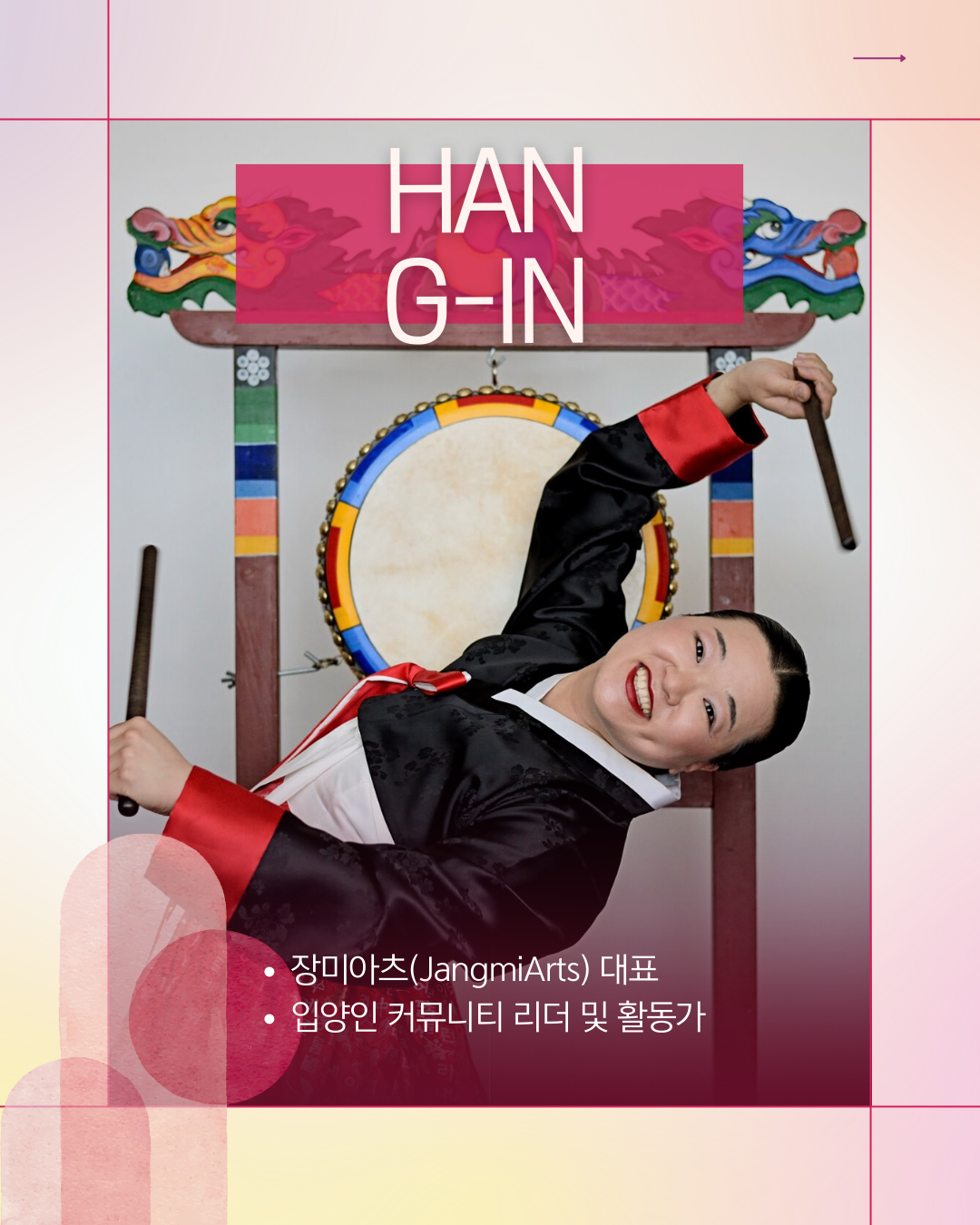
Han G-in - Director of JangmiArts

Gina Choi: Could you share however much you feel comfortable about your family background?
Han G-in: I was born in Seoul in 1979. There is very little support for single mothers in Korea and instead of being placed for adoption domestically, I was placed with a white American family in Minnesota, December of 1979. My mom is a retired librarian and my dad died in 2007. My brother Kyle is a biological child of my parents and is an orchestra and film composer in Los Angeles. I identify as a displaced Korean person, Korean American and a transcultural Adoptee.
Gina: More recently, you’ve been going by Han G-in instead of Brooke Newmaster. What made you decide to go by that name?
G-in: Jeein is the name a nurse at the orphanage gave me. The Chinese meaning is “merciful” and “full of wisdom”. They named thousands of babies. I’m sure they named each one with care but it also feels very generic and strange. I used to think a lot about the meaning of my Korean name when I was a kid and I prided myself to be a merciful person and act with wisdom. But when you grow up in a family that is not Korean, nobody can pronounce your name correctly. I didn’t want my friends or family to call me my Korean name if they could not pronounce it correctly. I had to decide at some point, does that name belong to me?
It was only the Korean people I met later in life that brought some truth to my Korean-ness. My Korean dance and drum teachers called me Jeein. Many instances friends of my Korean teachers commented how ugly the name “Brooke” was. It created some complex feelings for sure. I needed to dive deep and find out how I want others to refer to me and how I think of myself. Can a name be part of healing from cultural genocide?
Now when someone says my name, “G-in” it feels really good to me. That they see me and my history. I also use She and They pronouns and some friends refer to me as Hyung. I am a gender fluid person.
The social worker who was in charge of the placement of my adoption was present in my life all through my childhood into adulthood. Her name was Han Hyunsook. She was a strong, compassionate person and such an important person in my life. When she passed away a few years ago, I decided to take her last name as my last name. I wish I would have asked her for permission when she was alive, but I felt that her name suited me more than my birth father's last name, a man I will never know. My birth mother's name is private,
I also think that the concept of Korean Han feels very true to myself, so I think it's very appropriate. It has many multiple meanings, and I carry that with me in my identity.
Gina: What is your cultural identity and what does it mean to you?
G-in: I see myself as part of the worldwide Korean diaspora. I identify as a displaced Korean and a Korean American person. I feel that even though many of us do not grow up culturally Korean, we gain a sense of community and identity as we absorb more experiences and have more interactions with other Koreans worldwide. I feel a lot of kinship with other Korean people who have immigrated to different countries in the world, who maybe don’t feel accepted by culturally Korean people, nor by the culture that they've gone to.
I feel that Mrs. Han and some of the other Korean people in my life helped disrupt cultural assimilation into white American culture from when I was young. I was so interested as a kid to not just know more about Korean culture, but to be together with Korean people and participate in cultural ways.
My first trip back to Korea was when I was 12. On that trip, I was really struck by just the vast amount of information that I had very wrong about what it is to be Korean, and what is Korea. Displaced Korean Americans and Korean adoptees, we're taught certain facts about Korea, made to do certain Korean activities, cooked certain Korean foods, but it all felt so separate from what is truly Korean. That trip was a wake up call that there's so much more to experience and to know and to immerse myself in.
Gina: Can you talk about your background in Korean dance? How did you first get into it?
G-in: I went to the Korean Culture Camp (KCC) at Minnehaha Academy. There were so many adoptees that were exported from Korea to be purchased by white families that in the late ‘70s, those families made Korean culture summer camps, and there were 400 kids who were put into this particular camp one week a year to learn about their Korean heritage. When I was six years old, teacher Han Jiwon taught Korean dance at camp. She had learned Korean dance in Korea before she immigrated with her family. After KCC, some parents asked her to continue to teach Korean adoptee girls throughout the year, so her dad would drive her to North Saint Paul early every Saturday morning, and we practiced in the basement of a church. That was the best part of my week. Every Saturday, I got to be with Korean friends and see Jiwon and learn traditional dances. We started with children’s dances, like the puppet dance and the basket dance, then moved onto buchae-chum and gomu-chum and janggu-chum.
She was such a lovely, gentle person. And we were these raucous Korean American kids that were chatty and giggly. She had her hands full, but we all loved and respected her so much. When we became teenagers, she would invite us over to her apartment, which was a really big deal for us. She would cook us Korean marinated chicken wings and some side dishes and rice, and we'd sit around and eat Korean food and watch movies. She was really the only young Korean woman in my life, and so I think a lot of us modeled ourselves after some of her traits. She'll probably never know how important and special she was to all of us, and how much we treasured her, how much I treasure her still. She’s also part of my last name choice, Han.
For some reason, learning Korean dance felt very accessible and fun. Attempting to learn the Korean language can be very intimidating and embarrassing. The way that our tongues and mouths try to make Korean sounds feels so clumsy and like something's wrong with you. But learning how to do Korean movements, like slow dance-walking and turning and spinning and moving your fans gracefully, felt different. I was trying really hard, and I could see improvement week to week, and I believed I could move beautifully because Jiwon was teaching us how. It was a really positive feeling that maybe my movement can keep some of my Koreanness.
After that, I went to Korea, where I was able to see professional dancing and hear Korean music live for the first time. It was so emotional. I remember, of all places, my mom and I went to Lotte World, and they had this super cheesy folk village at the time. I think this was 1992. We're in the middle of all these roller coasters and food and shopping, and then one level of the mall was this folk village. There were not many people there, but there was a solo dancer doing this very expressive movement to hauntingly beautiful music. I had never heard that music or seen that kind of dance before. It was so different from the entertaining fan dance or drum dances. My eyes welled up with tears, and I just started crying. It was so beautiful, but at the same time, so upsetting. I learned later that that dance is called Salpuri. I did not know anything about that dance, but the movement and the music transcended that cultural barrier and hit me in the gut, emotionally. I certainly was enamored with Korean dance after that.
As I got older, I went back to Korea several more times. My dance group and their families, we all traveled together. We would stay at the different guest houses within the adoption societies and perform for the orphanage that we were from, as well as some other places. As a child, you don't know that you're being used for a political statement. They really wanted to make international adoption look very positive, and that we were all doing great, that we still could know about Korea and do Korean dance. At the time, we were so proud to show the single mothers and the special needs children at the Pyeongtaek facility our traditional dances. And the special needs kids would do Western band music for us, and it felt like a really wonderful exchange. At the same time, you felt full of sorrow because we met so many children that would not grow up in a typical family; they were being raised at the facility by social workers and doctors. Like I said, I don't agree with being used as a promotional, political statement from the adoption agencies, but I think as a young person, being able to meet others and have that cultural exchange was really meaningful and important for me.
After that, I went to different theaters in Korea. I went to folk village performances and the Seoul National Arts Center and the Sejong Center. And I saw a really excellent performance at the Jeongdong Theater.
When I came back to Minnesota, Jiwon was moving to California and asked me to continue teaching the group, which she had named the Jangmi Korean Dance Troupe. I was probably 17-18 at the time. In that handoff, I recognized there was so much that I did not know, and I wanted to learn so much more so I could teach the rest of the kids so much more. At the time, we had probably 40-50 kids in our dance group. So I hand-wrote a letter to the Jeongdong Theater and asked if they could help me find a Korean dance teacher, if there were any resources that I could tap into because I didn't know anyone outside of Minnesota.
That summer, I got a response back from the theater. An office worker actually called me on the telephone. He spoke a little bit of English, and he introduced me to a teacher in Korea. It was pretty extraordinary for him to go out of his way to do that. He introduced me to a really wonderful teacher, and then one of the teacher’s lead dancers was was tasked with teaching me gibon foundations of dance, and then the very basic but very complex dance of Taepyeongmu. These were my first professional dance classes, and I was so out of my depth. I was very scared, but the teachers were so kind and patient. We couldn't communicate with each other. I didn't speak Korean, only a handful of words, and they had pretty limited English. And so we built our friendship through our dance lessons. I learned how to tune in, how to watch her movement in a different way than I had done in the past. I could interpret her body language and expression, even when we were outside of dance class. Even if we were having a meal together or on a shopping errand, we still had a very good rapport through body language. I was so excited that I could find that kind of understanding with Korean artists even without being able to speak Korean. I felt a sense of belonging with them, and I credit these two teachers. I don't know what really was in their hearts, but I know that I was the first Korean American person to come to them to ask for lessons. They were so generous with their time and their resources, they did not ask me for a teaching fee or any kind of compensation. I knew from Mrs. Han to bring a gift from Minnesota, and I did offer them a learning fee that I hoped was appropriate. I remember the teacher, he took the envelope that had the money in it, and he didn't look in it. He just put it in his desk, looked at me, and nodded. I think he was saying, whatever this is, it's fine.
It took a while after being asked to teach the group in 1997 to then get the funding to go to Korea to learn. I went two different times, in 1999 then in 2001, to study with these two teachers. And I wish I could go back now as an older person to learn with them because at the time, I only knew buchaechum and children’s dances. Taepyeongmu was so complex and foreign to me. Now, I can see the wisdom with which they dared to bring that into my life at a time when I was not very advanced in my dancing. It was so challenging, but it profoundly set me up for understanding more about Korean traditional arts in the future.
I spent the next two decades traveling to Los Angeles and to Seoul to learn from different dance and drum teachers.
Gina: Can you talk about some of the important figures who have helped you in your journey with Korean traditional arts?
G-in: So I've mentioned Han Jiwon and Han Hyunsook… To be quite honest with you, there were not many Korean people who were super encouraging to me in my young life. When I was a teenager, I asked another Korean dance teacher in my city if I could take lessons with her, and she said no. She said, “That Brooke person is so strange. I do not like her, and I will never teach her.” She doesn't do anything with Korean dance anymore. I've actually since purchased her equipment, and she has since apologized to me as an adult and I have accepted. I will tell you, though, it spurred me on. I never would have written Jeongdong Theater if I hadn't had that rejection and received those mean-spirited remarks.
At that time, there was a pretty pronounced division between Korean adoptees and culturally Korean people. So many of us are not Christian, and it was very difficult to connect with Korean people if you weren’t part of their church. It really made us understand that if we want to belong to a community and celebrate Korean culture and not feel ashamed of where we are with that, we have to carve out our own community and make safe spaces for ourselves because Koreans and other people are not going to do it for you.
I do want to mention, though, one woman who was a profound role model for me. Her name is Jane Chung. She and her family ran the Chinese restaurant three blocks from my house in White Bear Lake called Pagoda. My family would go there for fancy dinners out, and it just was a special time to be able to go there. Every time, she would come by our table and make sure that I knew that I was special, that she saw that I was Korean, like she is and her children are. She would go back to the kitchen, and sneak kimchi on my plate, only for me, though. She would whisper in my ear, “You are Korean.” I'm so grateful for her affection and small gestures like that. It really made such an impact. She was the most beautiful Korean woman in my eyes. When you grow up in a family that is all white people, and your school district and community are also mostly white people, you are growing up Korean alone, and so you have to find out what it is to be Korean alone. So it was really special to have the help of these nice Korean women.
Both Mrs. Chung and Mrs. Han have passed away, and it's very strange to be getting older and have these elders gone. I carry with me that I haven't helped my community in the ways that I had always talked with Mrs. Han about. She had been the wind at my back, always pushing me to do more for me and to do more for others. After she passed away and then Mrs. Chung passed away, I felt so lonely. There was no one to check in with, no one to advise me or just sit and have a Korean meal with and have that quiet, really honest moment. But as more time goes by, I can feel that their strength is still with me. And I'm really glad about that, or I'm not sure I would have had the audacity to do some of the things that I've tried to do.
Gina: Are there any teachers you’d like to name as well?
G-in: Yes, Mrs. Han happened to be best friends with Lee Younghee, the gayageum national treasure. In the 2000s, we worked with Lee Younghee to bring artists from Korea to teach at the different adoptee camps. And then I met another teacher who did workshops for JangmiArts and some of the other Korean dance groups in the Twin Cities. I was so lucky to learn from so many different teachers because I know a lot of students learn with one line of teacher and you should probably stay there. We got to learn from many different teachers and different styles, and it was really good to learn like that for me at least. I really look up to those teachers. I think, though, because of the cultural barrier and the language barrier, I could not know them deeply, but I could learn a dance from them pretty well. And so maybe that's why I don't feel like I can speak more on the relationship that we had. It was pretty limited without having more complex conversations. I did have some positive experiences with some samulnori teachers because one did speak more fluent English and could interpret quite a bit. I was able to learn some fundamentals of drumming and just be introduced to it in a good way. But when you don't live in Korea, it's just these trips. You go for two to four weeks, you learn as much as you can, and then you come back to Minnesota, and then there's no real community to play with. And you just have to keep going. Instead of being the communal art it really is, for me, it was quite lonely. It didn't have the same joyfulness dancing or drumming together with others. For me, it was about learning as much as I can. I would take the lessons and document them in video to have a reference, and then it's doing the best you can off of those limited lessons. I wouldn't suggest that way for people to learn, but it's what I had.
Gina: What are you doing right now with the Korean cultural knowledge you've cultivated over the years? What is your role in your community?
G-in: I lead JangmiArts group that I inherited from Han Jiwon, and I’ve expanded the program to offer not only traditional dance but drumming and gayageum lessons. JangmiArts teachers teach dance and drumming at various Korean cultural camps for Korean Adoptees, their children and the wider Korean American community. I really want this to be sustainable and the resources to be available, especially to Korean Adoptees and their families. So I'm working on developing students who can become future teachers. I would like to get them lessons in Korea from cultural Korean experts so they have really good foundations and opportunities, similar to what I had but even better.
Korean adoptees are vulnerable learners because they’ve already experienced a great loss that non-adoptees have not, and then to immerse yourself in the culture that you’ve lost can be really terrifying. Also, I think it's so important to be open about LGBTQIA+ identities and orientations. I want to make sure to work with culturally Korean people who also have the well-being of marginalized groups like these in mind to keep them safe not only physically, but emotionally.
It’s challenging to be a queer person in Korean spaces, but at the same time, my experience has been that many teachers in Korea and Korean traditional artists are queer. They may not be open about it within the community, but everyone in the community already knows. I want to just be comfortable in my own skin being a queer person, and also make sure that my students can learn from someone who really values them and sees that as a wonderful thing to take the time to teach them. So that's really what I'm focused on this next year. I’m going to bring back some college-age students to Korea, but the focus will not be on how much they learn. It will be their well-being and introduction to learning from a culturally Korean person.
And the funny thing is, learning new drumming, rhythms, and techniques can be very challenging, but the main thing Korean American kids end up complaining about is having to sit on the floor all day — their body aches so badly! But they never once complain about the challenge of learning performing arts. They are hungry for it and are fueled by learning.
Gina: Do you have any advice or even hopes or expectations for Korean musicians who are trying to build careers abroad?
G-in: With the global popularity of Korean culture, mainly K-pop and K-dramas and Korean food, I'm so excited for Korean traditional artists to ride that wave, because I have met many American and European composers and musicians who are quite fascinated with Korean instruments. They’re looking for something different, something that is unfamiliar to them that they would like to learn about and incorporate into their compositions. My hope is for Korean traditional artists to be able to carve out careers doing that. I think being versatile in the things that they do, like being a recording artist, performer, composer, or orchestrator and collaborating with other global artists, is going to be key.
I also hope they have time to teach and develop students over the course of many years. One-off opportunities are important, and they should take them given the opportunity, but the lasting impact is going to be in ongoing lessons and a long-term student base, and maybe even developing new artists within their instrument and field.
I really hope that Korean traditional artists don't just get enamored with the white gaze and interest in Korean traditional arts. I think sometimes you'll be used, and that will pass. I really want Korean artists to invest in other Korean people who have either left Korea or been pulled away from Korea with no choice of our own. Please invest in us. We want to know, and we want to know deeply.
And some of us who have been teaching and performing Korean traditional arts in the US, we want to help you in any way we can by welcoming you and making connections.
Gina: Any final thoughts?
G-in: I think that people's race and heritage and background always plays an important role in how they got where they are, especially in Korean traditional arts. Some people think that it should be colorblind, and it shouldn’t matter where you come from. I disagree. Anyone is welcome to do it, but you cannot pretend to be from somewhere else and that it doesn't matter. Your cultural background is really important to how you came to Korean traditional arts. And so I just encourage people to be really honest about who they are and what their background is and what they're moving into. And when you fall in love with an art form, you just fall in love with it. Just, always be reverent about where it comes from, and be mindful about where you're taking it because it is specifically Korean, and it's special.
Gina Choi majored in Music at Cornell University (BA) and studied ethnomusicology focusing on Pungmul and Samulnori at the University of British Columbia (MA). She was the Program Coordinator at the Korean Performing Arts Institute of Chicago from 2020-2024, and is now a freelancer supporting professional and amateur Korean musicians in the US.
Han G-in is a transnational Korean adoptee who has learned Korean traditional dance from multiple teachers over many years. She is the Artistic Director of JangmiArts, a Korean traditional arts organization serving Korean adoptees and the larger Korean American community in Minnesota.
