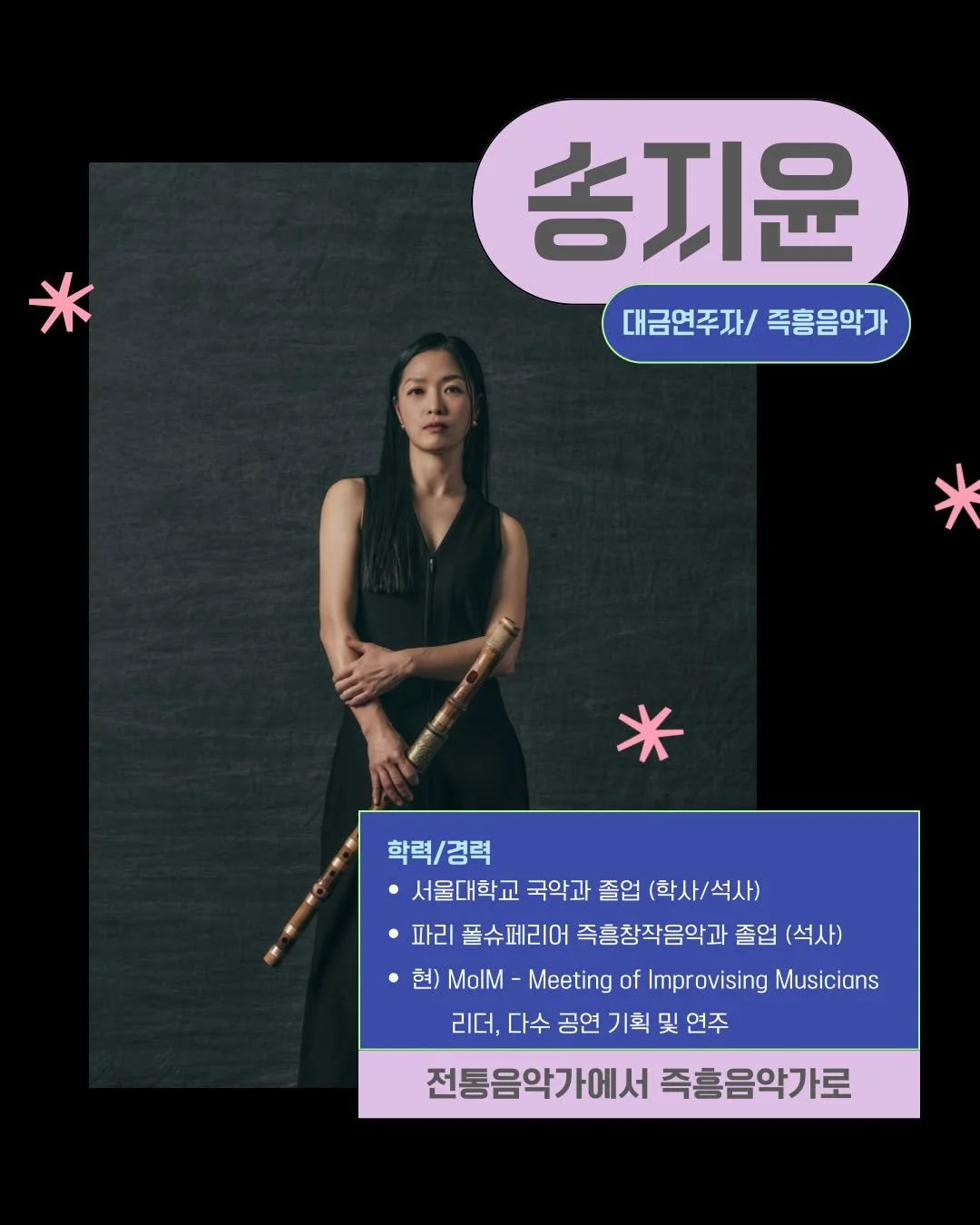
Jiyoon Song - Daegeum Performer and Improviser
Hyunchae Kim: How did you end up going abroad? What made you decide to study overseas?
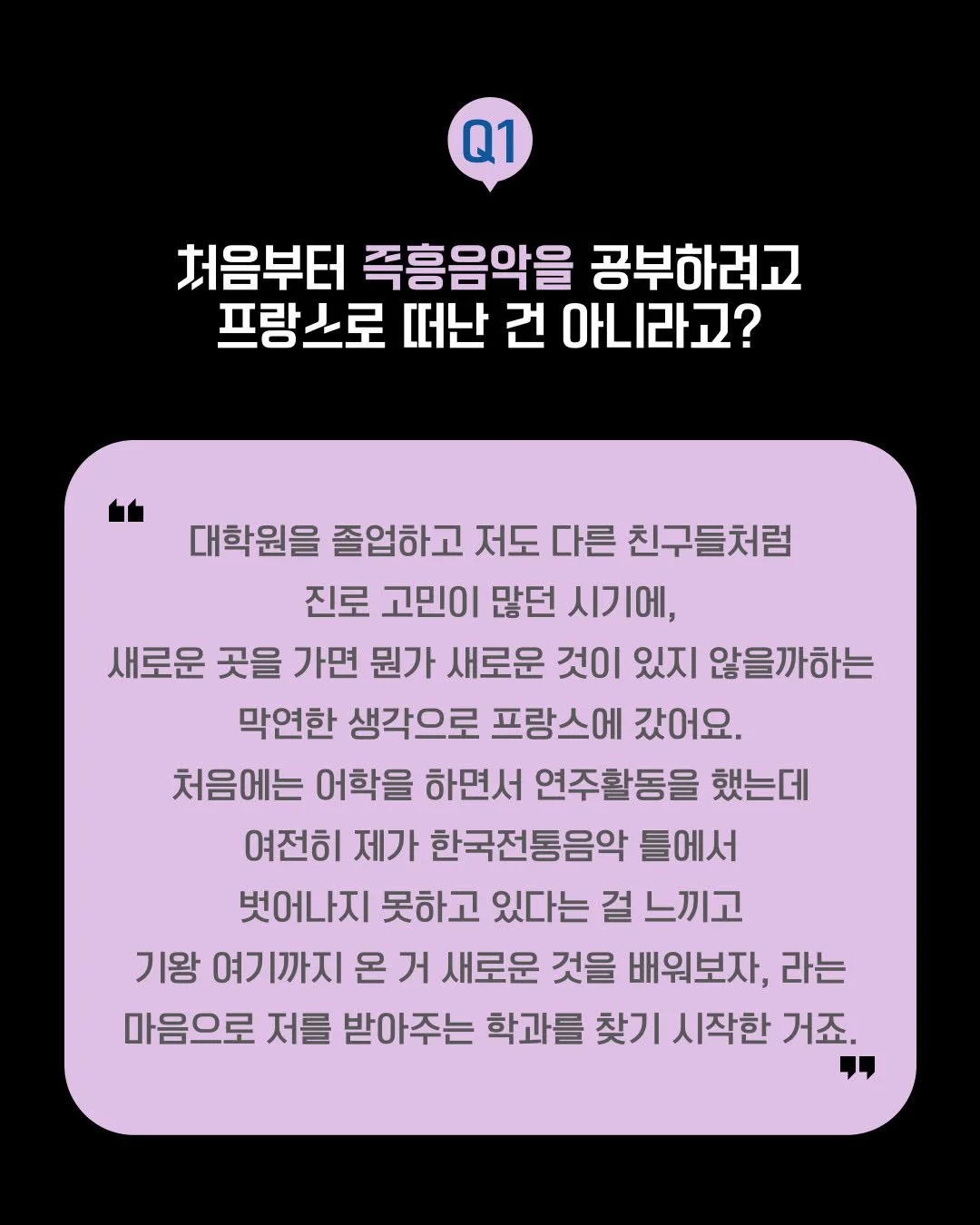
Jiyoon Song: While I was in graduate school, my desire to engage more seriously in a particular field grew a lot. As a daegeum player, I had opportunities to perform in orchestral settings and as a soloist, but I really wanted to form a group and try new kinds of work. So at that time, I was active in two ensembles. One was a group called Narirang. We won grand prize for the 21st-Century Korean Music Project. I also formed a group called Asian Music Ensemble AME, which brought together musicians from Korea, Mongolia, and Vietnam. We explored different Asian musical traditions together and created new works and have been active until just recently. After finishing graduate school, I spent about five years working like this as a freelancer, grappling with the same worries as everyone else. What do I want to do going forward? Should I audition for an orchestra? Or should I continue as a freelancer? Is that really the right path for me? I even auditioned for a position at a creative orchestra and made it to the final two, but was harshly rejected in the end (laughs).
Then at some point I started thinking: When I talk about my work, I always say that I draw on traditional motifs to create something new, but am I really? I wasn’t sure. But I thought maybe if I went someplace new, I’d find something new. Since I was already working as a freelancer, I wasn’t tied to any one place. So with that in mind, I went to Europe and tried to bring my musical activities there. At first, I applied to a program called “Sun Rising,” run by the Korean Cultural Center in Paris, which offers solo recital opportunities for young performers. I submitted documents and a video and was selected to perform.
Hyunchae Kim: What repertoire did you perform at that solo recital in Paris?
Jiyoon Song: At that time, I performed a mix of jeongak, sanjo, and contemporary pieces, basically the same repertoire I had performed in Korea. Later, with support from an international exchange grant, I brought the AME team with me and performed two solo concerts. I thought the music my group was doing would interest audiences in Europe, where Asian music is less familiar. And since I was already working on different Asian musics, I tried to expand on that. The performance spaces I connected with weren’t major theaters, but they were accessible multipurpose cultural spaces. I developed a portfolio and reached out to directors of those venues, and with some careful communication, I was able to make things happen. There’s also a major Asian museum called the Guimet Museum, and by connecting with their director, I ended up performing there as well.
Hyunchae Kim: It sounds like you worked extremely hard and put yourself out there as an artist.
Jiyoon Song: Oh, I made lots of offers. Since I didn’t know how things would turn out, I thought, “Let’s just see what happens.” I did everything I could to present my work overseas for about 1-2 years.
Hyunchae Kim: So you did all that before entering school? Why Paris, specifically?
Jiyoon Song: Personal reasons. I actually spent about six months in New York in my 3rd year of university, not because I wanted to study music, but because I wanted to live somewhere new and experience a different culture. If I had really felt that the U.S. was the right fit for me, I probably would have chosen to return there. I was actually surprised at myself for not choosing the U.S. I didn’t know it right away, but looking back, I think it’s because Europe moves at a slower pace, which suited me. “Slowness” can mean many things, but to me, it meant having enough time to continually develop my own perspective and ideas. In school, I was able to continually ask myself: Why am I doing this? Why is this necessary? What does this mean to me? I think Europe was a good fit because I had the time and space to keep turning these thoughts over in my head.
Hyunchae Kim: And then how did you end up deciding to pursue further study?
Jiyoon Song: As I performed across Europe, I noticed that Europeans are intensely curious about cultures and that they really enjoy learning about them. But although they enjoyed our music, I didn’t feel that it lead to other opportunities. It felt like things ended at “new and interesting,” there was no continuity. I felt I was being perceived solely as a traditional musician. But I had come here to find something new, so I couldn’t just keep performing traditional repertoire. Since it’s so easy to travel across Europe by train, I did wonder if maybe I should just keep traveling to different countries and perform Korean traditional music. Then I thought:= maybe school could be a good mechanism to help me move forward.
Hyunchae Kim: How did you find the right school and major for yourself?
Jiyoon Song: As for many Korean students, one option was to enroll in piano or vocal studies at a conservatory to get a student visa. The level wouldn’t have mattered too much, as you could just enter at a lower level. A language-study visa only lasts up to two years, but you could afterwards use your language proficiency to enter a conservatory. Musicology or music theory would have required studying in French, which is difficult, so Korean students often enter in performance areas like piano or voice. So I wondered whether I should learn the flute, since it's similar to the daegeum, or try to enter a jazz department… That’s how my search began—trying to find programs where I could use my instrument.
I made a list of conservatories around Paris on a sheet of paper, and there were about twenty-something. I put it on my desk and started checking them off one by one by researching online, visiting in person, talking to the office, and sending emails. If a school didn’t feel right, I crossed it off. Then, I heard from other Korean students studying Western music at these institutions that there was something at the Paris Conservatory. They mentioned a professor in the contemporary music department who happened to be a violinist of Korean descent. So a friend and I went to one of his concerts, and afterward I introduced myself and asked whether I might be able to enroll with my instrument. He said it might be possible, so I contacted him formally by email. But the problem was the entrance exam.
Hyunchae Kim: How did you prepare for the audition as someone who plays daegeum, a Korean traditional instrument?
There were designated pieces, but no matter how I tried to adapt them to the daegeum, it was not doable. I agonized over it for nearly a year. I went to conservatories, crossed them off my list, and kept banging my head against the wall. Then I found out that one of the Paris conservatories not far from where I lived had an improvisation department. And their recruitment guidelines said there were no instrument restrictions. So I emailed them, waited for the audition date, and auditioned. When I got there, about 20 people were sitting in a circle. Then I learned that the improvisation department was only in its second year of existence. So it had barely just begun—the first of its kind in Europe, created in Paris.
Hyunchae Kim: What great timing!
Jiyoon Song: It really was, and the audition called for a free-choice piece. It felt like a ray of light. If I remember correctly, I played something that showcased traditional techniques, like a cadenzal section using the daegeum’s airy sound, while also attempting some improvisation. The audition lasted about 20 minutes. Surprisingly, they gave the results right on the spot. There were about four or five who auditioned. After everyone was done, they called us all in and announced the accepted students in front of everyone. Three of us were accepted, including me. I remember feeling so happy on my way home.
Hyunchae Kim: The result must have felt even more meaningful after such a long search and so much deliberation. How was the learning process?
Jiyoon Song: I remember improvising on stage for the first time in Paris. I performed with two professional improvisers. That one hour was incredibly intense. They taught me things in that short hour that I couldn’t have learned through formal training at any school. It was my first time experiencing what improvisational music really is. They were so experienced that I felt guided by them. All the thought processes in my head about what sound I should make and how I should play disappeared, and sound and music started flowing freely through our exchange of energy. It felt like everything inside me poured out. Almost like being possessed? I think I was drawn to improvisation before I fully understood it.
Hyunchae Kim: What does improvisation actually involve?
Jiyoon Song: There are many ways to improvise. Some people describe improvisation as music without structure, but if you want structure, you can create structure. Ultimately, it’s about freely expressing whatever music is inside of you. For example, if you improvise a conversation with someone, your words reflect your thoughts and the kind of person that you are. Music improvisation is similar. It’s about what kind of music you do, what musical materials you have, what musical experiences you’ve accumulated, and how you express them. And it’s a process of refining those skills. Even if you have a lot of material you’ve accumulated over time, if you haven’t refined your expression, it can be difficult to bring it out in improvisation. So you’re continuously honing the skills that allow you to express yourself faithfully.
Hyunchae Kim: Maybe that’s why—When I first heard improvisation, I felt it was difficult to listen to, but when I saw your performance a few years ago, it felt very polished, like you were only making the sounds that were necessary. Even though it’s improvisation, do you set the direction of what you will play?
Jiyoon Song: Yes, there is direction. I have ideas about what kind of music I want to create, what I want to express in that moment. And each performer has their own style.
Hyunchae Kim: Interesting. What about after you finished your master’s program?
Jiyoon Song: After my graduation recital, I was debating whether to return to Korea. Then completely by chance, while searching online, I discovered that a new advanced program in improvisation and creative music had been created at the Pôle Supérieur in Paris. This program combined the three conservatories in Paris—the municipal conservatory, the superior conservatory, and the Boulogne Conservatory—into one integrated program taught by rotating faculty. It had just entered its second year when I discovered it. I learned about it three days before the application deadline and rushed to apply. The audition was long—about three to four hours—and the tone was already different. The audition consisted of two designated pieces, one free piece, and an interview. One of the designated pieces was not given in advance. When I entered the room, there were two huge speakers that suddenly started playing electronic music consisting of white noise, and we had to improvise to it. Thankfully, I got into the Master’s program. For the degree, I studied performance at the conservatory and theory at the university.
Hyunchae Kim: It sounds like your desire to continue learning was very strong. Where does that drive come from?
Jiyoon Song: There, I was essentially a nobody—a stranger. No matter what school I graduated from in Korea or what I had done before, no one knew. So the moment I enrolled in the school, I felt I was starting again from zero. Because I needed to make up for that zero, I couldn’t help but feel constantly behind. At one point, I wanted to show my professor that I could do new, nontraditional techniques on the daegeum. But the professor listened and said, “Your music is too traditional. Jiyoon, you have to break out of that.” It was shocking. That started a process of questioning what “traditional” even means and breaking my own preconceptions. It was like resetting myself.
Hyunchae Kim: Improvisation seems like it requires a lot of experience. Do you have any personal techniques or tricks?
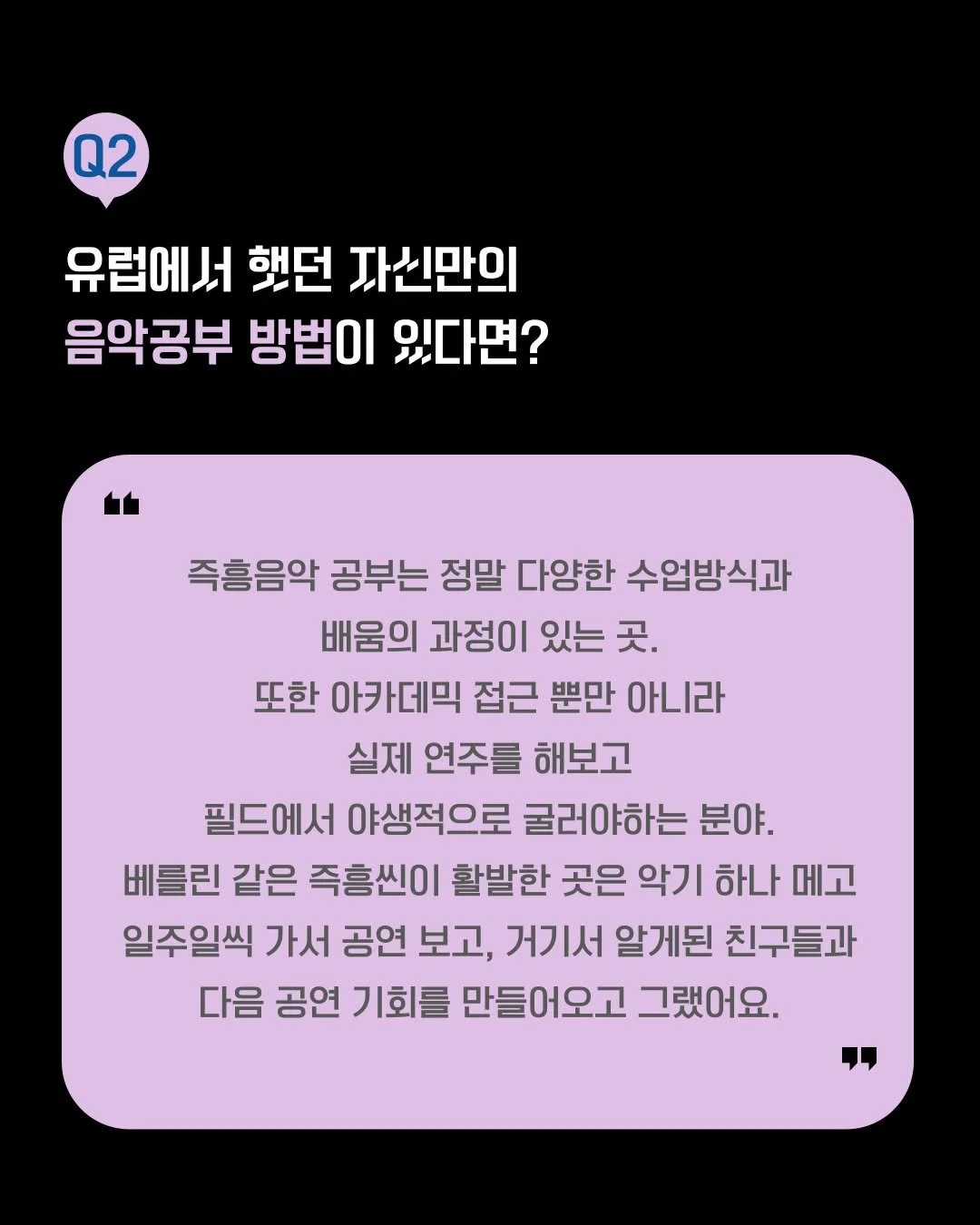
Jiyoon Song: I tried to gain as much field experience as I could. I often went to Berlin. I researched where I could hear good music, packed my instrument, took the train, and spent a week at a time there on my own dime doing these self-directed study retreats. I went two or three times a year—attended performances, jammed with musicians I met, created performance opportunities for my next visit. I felt that understanding this music required both field experience out in the wild and structured training in school, so I kept doing both.
Hyunchae Kim: I heard that after returning to Korea, you’ve been running an improvisation group. Can you tell us about it?
Jiyoon Song: I run a monthly workshop called MOIM. I created it to lower the entry barrier to improvisation. You need experience to know whether you actually like this music or not, or to know that something like even this exists. You have to actually improvise in order to develop your expression, learn how to listen, and build ensemble sensitivity. Overseas, classical and other music students are exposed to these experiences, but in Korea, it’s harder to find improvisation classes and the training methods, though they exist, are not widely accessible—which is why I created MOIM. People can just come watch and see, “Oh, so this is what it’s like. Maybe I should try it.” The idea is that everything goes here.
Hyunchae Kim: What advice would you give to students preparing to study abroad?
Jiyoon Song: If you want to adapt quickly, invest time in language study. The faster you learn the language, the faster you’ll adapt and the more likely you’ll approach the culture with an open mind. It also helps you develop a mindset of wanting to accept and exchange people and ideas. I’m a true introvert—I love being alone and would prefer to just attend class and go home, but I made an effort to interact with people because making connections is essential. If classmates went out to smoke, I’d grab a coffee and follow them. I often didn’t even understand what they were saying, but I stayed and listened. When I went to Berlin, I sometimes messaged people on Facebook, even though I didn’t know them. I’d go to gatherings after concerts with a glass of wine or beer and just listen. You need that kind of mindset.
Even now, living in Korea, I go to Europe at least once a year. If I feel I need to search for something, I pay my own way and spend a week to ten days watching performances and exploring venues. It’s part of finding my artistic path, and that’s something I should do whether I’m living in Korea or abroad. I think that applies no matter where you are.
Hyunchae Kim graduated from the Department of Korean Music at Seoul National University with a Doctor of Musical Arts (DMA), formerly served as a lecturer in the Department of Korean Music at Seoul National University, and is currently an Artist in Residence at the Korean Performing Arts Institute of Chicago (KPAC). She is also the Founding Director of Stringway.
Jiyoon Song earned her B.A. and M.A. from the Department of Korean Music at Seoul National University, went on to receive an Master’s degree in Improvisational Music from the Pôle Supérieur in Paris, and is currently organizing performances and continuing to perform as the leader of MoIM (Meeting of Improvising Musicians).