
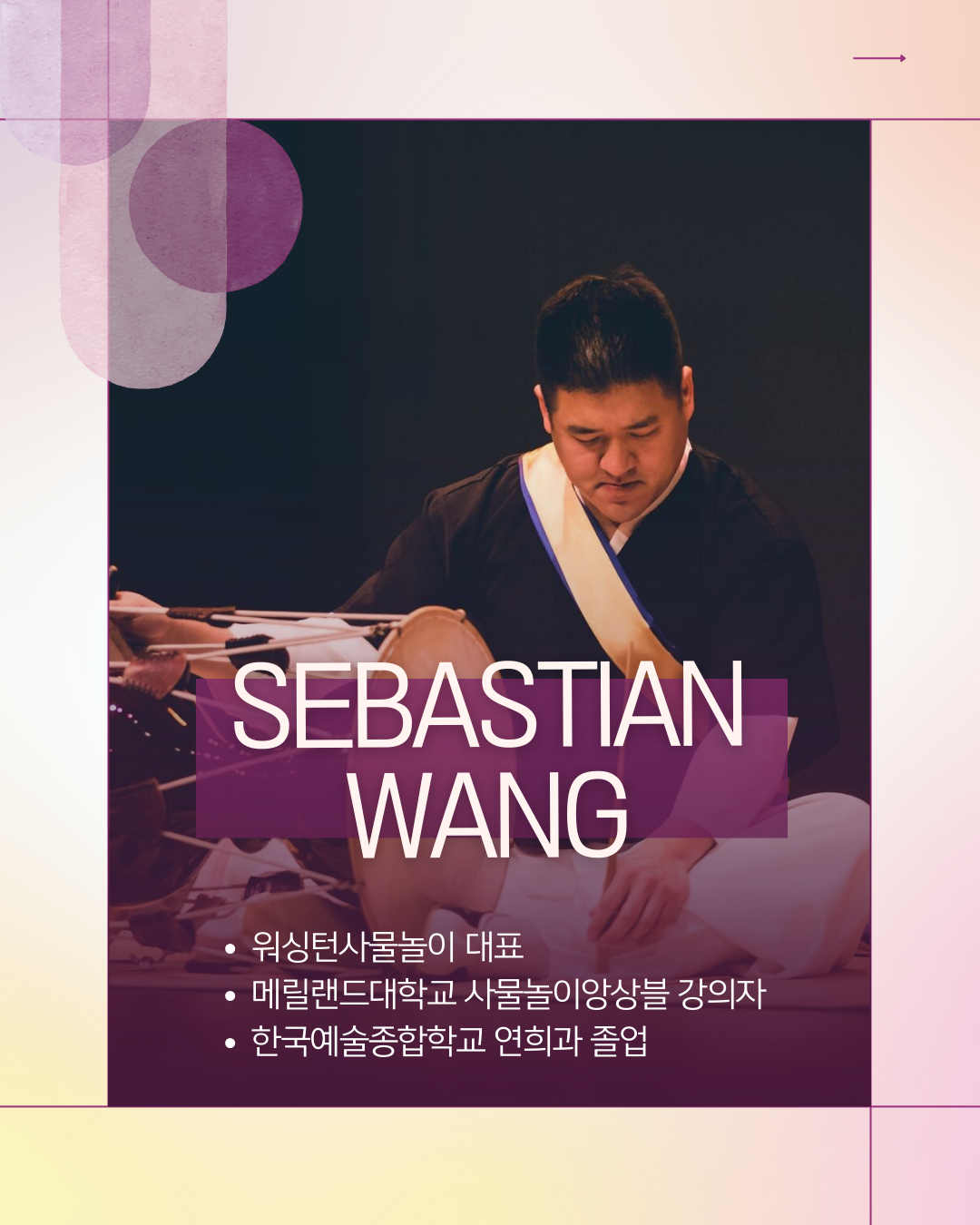
Sebastian Wang - Director of Washington Samulnori


Gina Choi: What is your cultural identity and how important is it to you?
Sebastian Wang: I am a Korean-Chinese American. I identify more with my Korean side, because I specialize in Korean music. It definitely brought me closer to my Korean heritage and the culture in general. Because of my relationship with music, some people treat me as if I'm a full Korean, which can be good and bad. Even though Korean music is something that I enjoy immensely and am able to understand as part of my heritage, I never forget that I'm mixed. I don't ignore my Chinese side. I acknowledge that my father is Chinese, but I've just been able to experience more of my Korean heritage than my Chinese heritage. Growing up here in the States as an Asian American with a mixed culture has been interesting. When I was growing up, there weren't really any. Now it's more common, but it was a challenge growing up. But through the music and exposure to the culture in general, my Korean side has really been a key part of my life.
Gina: How did you get into Korean drumming?
Sebastian: When I was about six or seven, my mom brought me to a Korean film festival at American University that she was helping out with, and there was a samulnori team performing there. I just immediately fell in love with it. It was a local team from the DC area. They were students from Korea attending the University of Maryland. I started to go to their practices just to watch. I did that for a couple years. I was too young to learn, and I didn't have my own instrument. In second or third grade, I moved to Korea for a couple years because of my mother's job, and the leader of the U of M samulnori group also went to Korea to study under Kim Duksoo. He invited me to be in the same spaces as Samul Kwangdae and the other Hanullim performance teams that were forming in the early ‘90s. Later, he moved back to the DC area, and so did we. From about ‘94 on, I learned under him, performing in middle school all the way through high school. Then I had a choice: either continue pursuing this or not.
I got very lucky. Kim Dongwon was performing with Yo Yo Ma as part of the original Silk Road Ensemble at the Smithsonian folk life festival. Long story short, we met Kim Dongwon, he talked to Kim Duksoo in Korea, and Master Kim told us to ship me over to Korea and to audition for the Korea National University of Arts (K-Arts). And that's exactly what I did. I studied under Shin Chansun from Samul Kwangdae to prepare for my auditions. I got in, went to school for four years, and earned my bachelor’s degree. I worked for Kim Duksoo directly my senior year as Samulnori Hanullim’s overseas coordinator, after Katherine Lee handed me the reins. After graduating, I returned to America, and shortly after, Dr. Robert Provine helped me create the Korean percussion ensemble at the University of Maryland in 2009. Then in 2015, I created my own group Washington Samulnori. I’ve been teaching and performing ever since.
Gina: At the time, were you the only non Korean national in the program?
Sebastian: I was the third. The first was a Korean from Germany and the second from Japan. I was the first American and the third foreigner to be accepted into and graduate from the program. After me, I believe there were others from Canada, Japan, and the US.
Gina: As a Korean American, was it difficult for you to find access to training and resources, and what do you think could improve access for future individuals like you?
Sebastian: I got very lucky, being exposed to a local team. If I had not had that opportunity, I think I would never have even gotten into it. When I was growing up, there were no resources, period. Now, because of the internet, I think it would be easier, but it was very difficult back then. Even when I returned after graduating from K-Arts, resources were very limited. I had no idea who was doing what, or where they were. The only way I was able to get going was by working with the local Korean dance academies here in the DC area, one of which I worked very closely with growing up. Through that, I was able to gain connections. And more resources became available to me once I started working at the University of Maryland, but getting to that point was a huge challenge.
Gina: Was it hard to prove yourself when you got back, or was there a specific event or milestone that set the tone?
Sebastian: I did have to prove myself because even though Korea National University of Arts is very well known in Korea, it's not known here at all. I did try to give the idea that it is somewhat comparable to Juilliard, but I didn't really want to push my ego. I just wanted to give some sort of reference point, because they had no idea. What does that mean, Korea National University of Arts? Where is that? But through experience and exposure, I started getting more recognition and working with the Korean Cultural Center, as well. Luckily, they know K-arts, so that helped a little bit. But it was difficult in the beginning. Dr. Provine definitely helped. His credentials and vouching for me that I’m going to be the one leading the ensemble at Maryland definitely helped.
Gina: Did being Korean Chinese American ever get in the way of other people acknowledging your qualifications?
Sebastian: Even when I'm introduced as Sebastian Wang, the director of Washington Samulnori or the Korean percussion ensemble at the University of Maryland, they're like, “Wait a minute, this is, this doesn't add up.” You know, on paper, I sound Chinese because my last name is Chinese. So yeah, it's definitely been challenging.
Gina: Did you at any point consider working in Korea instead of coming back to the US or was it always the plan to come back?
Sebastian: It was always the plan. You know, one thing I've discovered when I was living in Korea and going to school there, there are so many gugak musicians, and the competition is so high. On a base skill level, I was already behind because in Korea, they decide their majors in high school, so they already have a leg up on me, and they know the environment because they grew up there. But none of them speak English or grew up in America. I always wanted to work mainly in the DC area because I am a native. That was always my goal, to bring samulnori to America, especially in a more professional manner. English is my first language, and the resources here, as I mentioned earlier, were very limited. I wanted to become a resource for others, as well.
Gina: As someone who does Korean music in the States, what are some of the challenges you face?
Sebastian: Some of the main challenges in the beginning were making connections and getting exposure. There was very limited networking, and the challenge I faced specific to samulnori was not having enough people. It was just myself, and it's a four person ensemble minimum. I tried to get involved with the college groups in New York State and the camp that they used to run every year to recruit people who would be interested in learning and eventually performing. I did find some people, but even after I did, it was difficult to get exposure and recognition of our skill and our genre of music. Even after I first created my group Washington Samulnori in 2015, some of the members, their lives changed and they had to move away, and I had to readjust and re-recruit. Having enough people for Washington Samulnori is still a big challenge. And one step up from that is just networking with other gugak musicians in the States.
Gina: Do you have any advice for Korean traditional music musicians trying to build a career either in the US or abroad?
Sebastian: I would say the best thing would be to try to establish a relationship with someone who's already in America, whether they play the same instrument or not. You can try to do it on your own, but it's so much more difficult. Whether it be certain individuals like myself, or organizations like KPAC, or even even other performing arts groups, like a dance company. I think it’s also good to work with the Korean Cultural Centers in America because they want Korean traditional musicians and programs. I myself have worked very closely with the Washington Korean Cultural Center; they support and recognize my artistic abilities. And you know, it’s been amazing to work with the members of my group.
Additionally, have a specific vision of what you want to do. For example, fusion with a very specific kind of music. I think I initially didn't really have a plan because there was no one to talk to. I guess the next suggestion would be talk to people, get some opinions. But don't just talk to one person, talk to as many people as you can. And if you’re looking for similar things, then continue that relationship. Start with some sort of connection or plan, and get as much information as you can. It may evolve over time, but having an idea of what you’re trying to accomplish and having more information, I think, would make it much easier.
Gina: What is it that you want to do, big picture, with Korean music?
Sebastian: My goal has always kind of been to have samulnori be recognized. Just to be recognized that it's Korean music, in the same way that Taiko has been recognized all over the world. They don't even need to know that it's called samulnori, but just to recognize, “Oh, that's Korean drumming,” whether through the pure musical aspect, the instrumentation, the rhythms, the energy, or even the look. Also, my goal is also to represent it in a professional manner. I do understand that it is very difficult to get to that level, but to be frank, I don't appreciate amateur versions of Korean percussion in more professional spaces, like at big festivals. People who are not familiar, their reaction is, “Oh, that was terrible,” or “That was just okay. I guess that's all Korean percussion.” I would prefer to have them react with, “Oh my gosh, that was amazing. This is so cool, so interesting. I want to find out more about it.” And being an English speaker, I would love to tell them all about it and to maybe even help them learn how to play.
So exposure of samulnori and Korean percussion is really my goal. In some ways, it is sort of unattainable because there's so much out there, but it's still possible, and I'm still working at it. It has been easier recently because there are more other organizations now, many of which are doing things on a professional level. I think that it is time to get to that level and that we have the resources to do so. Every day, there are more and more gugak musicians all over the world who produce professional quality performances and are good representations of their craft. Take orchestral music as an example. To the average bystander, it's very easy to distinguish amateur performances from professional ones. But for people who are not aware of Korean percussion or performing arts, they might not know the difference. And my fear is that, some people might see an amateur or intermediate group and make all their judgments based on that, where I'd rather they see a performance on a very high level, if possible.
Gina: Do you have any hopes or expectations from Korean musicians who might be trying to build careers abroad?
Sebastian: You know, I hope they do it. But like I said, I hope they also connect with people so that they can help each other. I think one thing I've discovered through different conferences is that there are a lot of us, but we’re all kind of doing our own thing. I wish we would work together more because a lot of times, we are often doing the same thing or our goals are similar. And share resources. Being a one-man army is very difficult. I've had to really get out of my comfort zone to get and promote performances, which would have been a lot easier with partners. Since then, I’ve worked with different groups like dance companies, or even with the Korean Cultural Center. I hope that we can all work together and really expand exposure of Korean traditional performing arts in America and abroad, so that it is as well known as taiko drumming from Japan, for example.
Even when a big shot like Master Kim Duksoo from Korea comes to the US, it's good for the moment, but it's not a continuous relationship. The artists who are living here, we can make continuous relationships with the different communities that we're in. Maybe overtime, even plan tours all over the US, have regional representatives, or just partner with each other occasionally. I think that will create a better future for all of us. But I understand that at the same time, America is very large, even just the physical distance can be a problem. I've worked with New York musicians quite a bit, but that does create a lot of logistical problems, payment problems, and things like that. So it is easier said than done, but ideally, if we could all work together and pull our resources together, I think it would benefit everybody.
Gina: Any final thoughts for Korean musicians in Korea trying to build their careers abroad?
Sebastian: Yeah, so I would say have a vision of what you want to do. Try to prepare as much as you can. Try to get as much training as you can in whatever you're trying to do. And even if it fails, don't give up. Things might happen when you least expect it. If there are people that you can partner with, partner with them. You might meet people along the way that will completely change things for you, whether it be in Korea or over abroad. So establish relationships with as many musicians or people as you can who are interested in the music you want to do. For me, it is traditional, so partnering with the Korean Cultural Center makes sense. But if you're doing something a little bit more abstract, then you need to find the audiences or organizations who are interested in that. Let's say you want to go on tour. Find an agent that can sell what you are trying to produce. And seek out individuals who have done it before you.
Koreans can be very prideful in the sense that, “I did this, and it's my thing,” but I think they can also have a good attitude of, “Let's do it together.” If you can do it with someone, it's so much easier and so much more rewarding. If you do it by yourself, it can get very depressing, to be very frank, and you may doubt yourself. I honestly have considered giving up many times, especially because my music is ensemble music and I was often on my own. Having some sort of community or shared experience with an individual or organization will be far more rewarding. Even if it takes a while, it will make the journey easier. It's been great for me to meet different individuals, including you and others, people at the university and the Korean Cultural Center. And things change as you go along, but adapting to those changes is also good.
The final thing I'm also thinking about these days is, who is your target audience? Who are you trying to connect with? I'm trying to be an example of Korean percussion for whoever wants it, but especially other Korean Americans. I want to help people connect to their Korean heritage through music, just like I did. For example, I’ve been teaching at the Korean Heritage Camp in Colorado since 2007. It’s a Korean culture camp for Korean adoptees. Being there, showing them the music, being a positive influence on their life has been very rewarding, for them and for me.
Gina Choi majored in Music at Cornell University (BA) and studied ethnomusicology focusing on Pungmul and Samulnori at the University of British Columbia (MA). She was the Program Coordinator at the Korean Performing Arts Institute of Chicago from 2020-2024, and is now a freelancer supporting professional and amateur Korean musicians in the US.
Sebastian Wang studied Yeonhui at the Korea National University of Arts (K-Arts). He is the Director of the Korean Percussion Ensemble at the University of Maryland, as well as the Founder and Director of Washington Samulnori.
