
Sunghong Kim - PhD in Ethnomusicoogy

Hyunchae Kim: Could you start by introducing yourself?
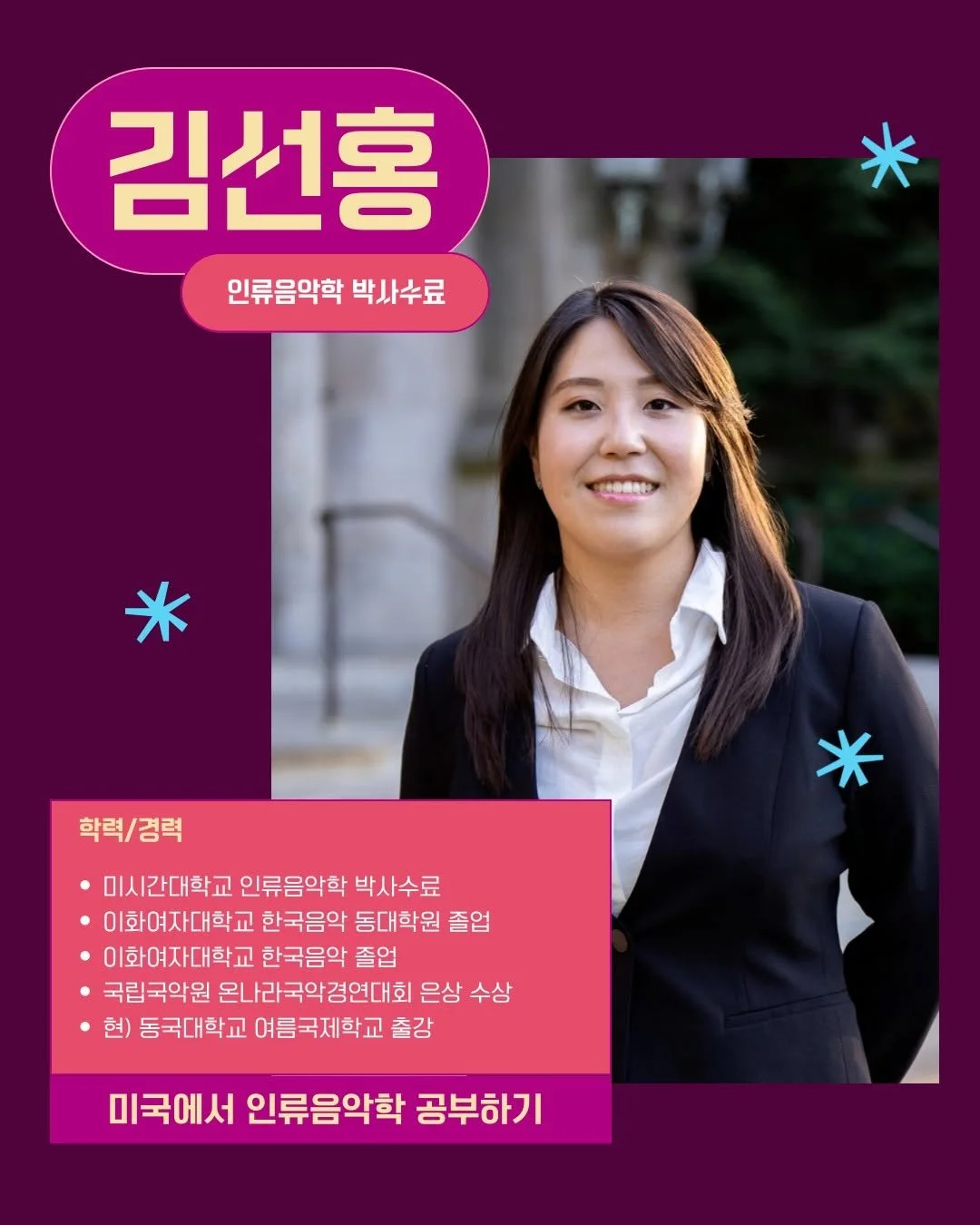
Sunhong Kim: Sure. I’m currently a 5th-year PhD candidate in Ethnomusicology at the University of Michigan School of Music, Theater & Dance. My dissertation focuses on music that expresses Korean identity. I’m researching not only Korean traditional music (gugak), which I specialized in as a gugak major in high school and college, but also other musical forms from a broader perspective.
Hyunchae Kim: You majored in piri and completed your Master’s in Korea. What made you decide to study abroad in a new field like ethnomusicology?
Sunhong Kim: When I was in my master’s program—this was in 2018—I had a chance to interact with people performing Eunyul Talchum, a style of mask dance drama originating from the region after which it is named. That experience gave me a new perspective on music. For me, performing music had been about developing my professional skills. But for these performers, music was closely tied to their personal lives. That sparked my interest in research, and as I became inspired by the stories of real people living in the modern world, I became drawn to the humanities.
Hyunchae Kim: Eunyul Talchum originates from the northern region, right? Were the performers people who had come down from the North?
Sunhong Kim: Yes. Eunyul Talchum used to be performed in the North , and most of the teachers who continued the tradition were second- or third-generation refugees. More than 30% of the people who migrated from Hwanghae Province settled in Incheon, which is why Eunyul Talchum has experienced a revival there, specifically. Seeing how these individuals found joy and preserved their identities through music, even after they were displaced from their homes, was very inspiring to me. The timing also lined up with restoration projects and folk arts competitions, and eventually Eunyul Talchum was designated an Intangible Cultural Asset. Another northern tradition, Gangryeong Talchum, was also designated around the same time. As a music major, I found it fascinating and strange that these people were working so hard—not to build “professional expertise” like I was, but because it meant something deeply personal to them.
Hyunchae Kim: As a musician, that must have really shifted your perspective.
Sunhong Kim: It did. Talking with them also changed the way I viewed North Korea. I was born and raised in Daegu, so I grew up influenced by anti-communist ideology. When I was in middle school, a North Korean defector visited our school to give a guest lecture, and hearing the hardships they endured made North Korea feel like a harsh and distant place. But after spending time with these performers, I started thinking, “North Korea is part of our country.” My subjective sense of “us” broadened. They told me that they visited elementary schools through a Ministry of Culture, Sports, and Tourism program, introducing themselves as coming from North Korea and explaining that Hwanghae Province culture is part of our heritage, to which some students responded, “But North Korea isn’t our country.” The performers were shocked and frustrated by that. I started thinking that North Korean civilians—ordinary people—should be seen separately from the regime’s political image.
Hyunchae Kim: How did you then decide to study in the U.S.?
Sunhong Kim: My specialty is traditional performance, and I didn’t want to abandon that. I didn’t want to start over in something completely different. I had worked really hard to gain the knowledge I had and to become an expert in my field; I didn’t want that effort to go to waste. I could have dropped my Master’s in performance to pursue my PhD, but I wanted to finish what I had started, so I started studying ethnomusicology as I was completing my Master’s. I audited a thesis seminar in the anthropology department at Seoul National University and learned that, in fact, many gugak performers pursue PhDs in anthropology, which made me realize that I could, too. I chose the U.S. partly because I already spoke some English, and also because some American programs offer funding opportunities that could cover tuition, living expenses, and/or health insurance, whereas European programs generally do not.
Hyunchae Kim: Which schools did you look into?
Sunhong Kim: I searched for ethnomusicology programs rather than specific schools. I applied to around ten schools, and I was accepted to several, but Michigan offered the most funding. During my research, I noticed that the University of Michigan also happened to have an excellent Korean Studies institute. They host an annual conference for graduate students and have a strong Asian studies department.
Hyunchae Kim: Can I ask how much the scholarship was?
Sunhong Kim: I don’t remember exactly, but before getting into Michigan, I was working at the National Gugak Center under a long-term contract—and Michigan offered more than my salary. Full tuition plus a monthly stipend, plus health insurance, all funded for five years. Every three years the graduate student union negotiates adjustments based on inflation. So even though doctoral funding is a five-year contract, the administration increases stipends to match inflation because of those negotiations.
Hyunchae Kim: But you can’t really compare amounts directly because the cost of living is different in Korea and the U.S. Was it enough to live on as a grad student?
Sunhong Kim: It was enough. It depends on the person, but in my case, the amount exceeded the federal government’s cost-of-living estimate for the region. You could save more by having a roommate, living in student housing, or buying a car and living farther out—there are ways to reduce costs significantly.
Hyunchae Kim: Ethnomusicology research often requires money. Does the school also pay for research expenses?
Sunhong Kim: Yes. The school regularly offers various internal research grants you can apply for. For example, I studied Chinese as my second foreign language, and there’s a language training award offered by certain institutes outside the department. I wrote a budget proposal and applied to them for tuition and housing costs for that program. There are many different types of grant opportunities you can apply for. The department also has its own funds, so you can apply for summer research support or ask for additional funding if what you received wasn’t enough.
Hyunchae Kim: So the funding was stable, but studying abroad must still have been difficult in other ways. What was hard for you?
Sunhong Kim: It would be a lie to say nothing was hard. Daily life wasn’t too difficult. When I arrived, it was during COVID, so I couldn’t meet many people—I mostly interacted with my roommate. Language-wise, I like meeting people, so even though my English wasn’t great at first, I kept talking and pushed myself to grow. When you really need something, you can usually get your point across with simple English and body language, so I didn’t see that as a huge problem. The real difficulty hit in class. I had to give presentations, submit papers, and continuously show my professors the research I was working on. The school was funding me to carry out my research, so I felt pressure to prove that I was doing the work. If you take three classes, you read at least four or five 20-page articles per week. Sometimes you’re assigned an entire book on top of multiple articles. Keeping up with those readings in English was incredibly hard.
Hyunchae Kim: Wow—and all in English. I can’t even imagine.
Sunhong Kim: Thankfully, the senior students gave me lots of advice. Since everything is essay-based in the U.S., they told me what to read first, what to skim, and so on. And when I got stuck, I would search YouTube for explanations of certain theories or scholars. One of the hardest parts was that even though I roughly understood Western music history, I didn’t know specific musical examples. So much of the musicological theories and discourse were so Euro-centric, it felt almost violent to me. I came to study ethnomusicology and research the music I had specialized in, but I had little time to delve into research because I had to relearn and reframe everything from a Western perspective. That was really hard for me.
Hyunchae Kim: What is your dissertation about? And how does it relate to your experience as a gugak performer?
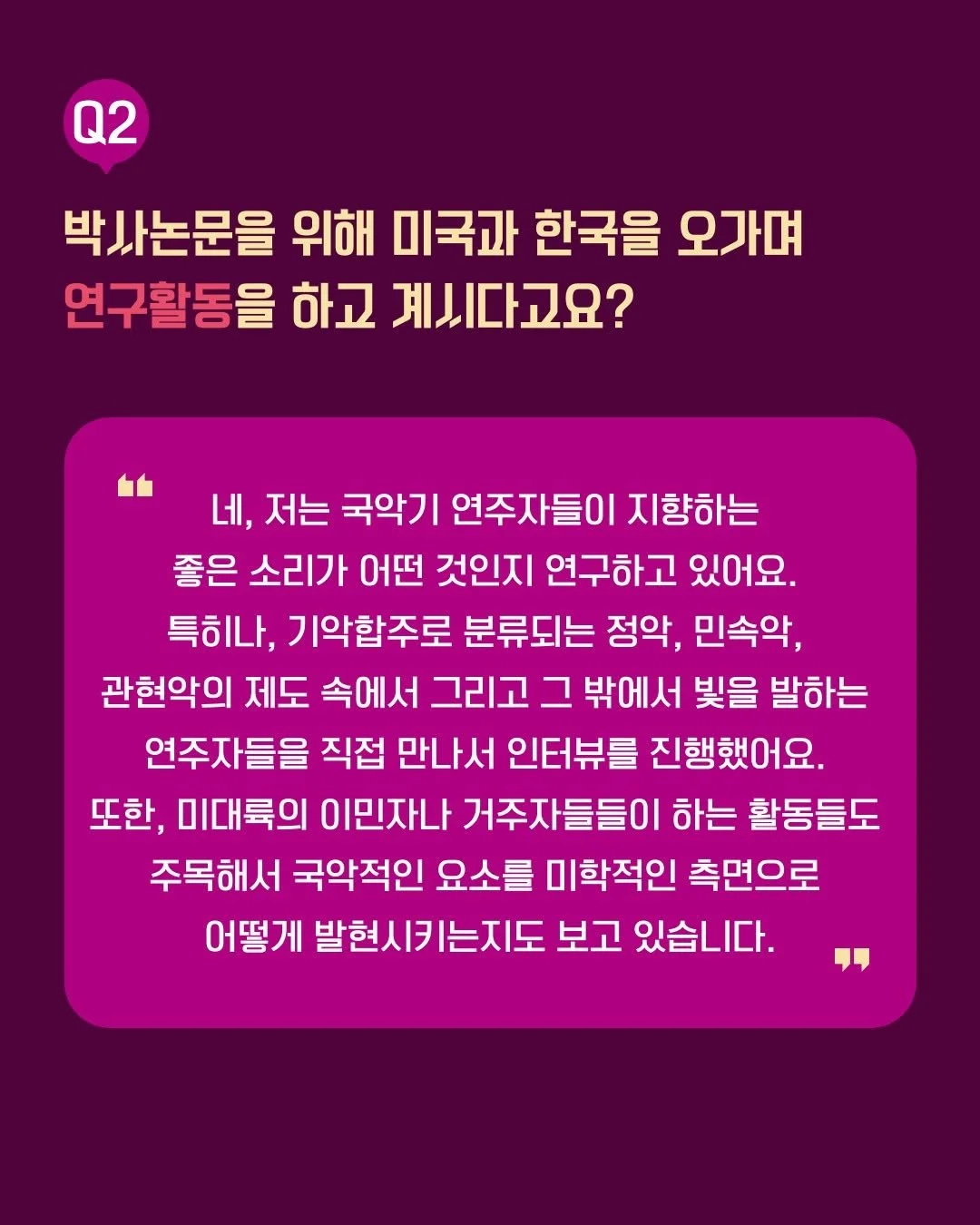
Sunhong Kim: Many gugak majors go on to develop professional careers as performers, and I wanted to examine what their motivations are. I think their technical skills are incredibly important. Performers develop their own technique, but how do they make and express aesthetic choices? I interviewed instrumentalists about what they consider a “good sound.” How do gugak musicians pursue the goal of making a good sound? Gugak ensembles can be classified into three categories—jeongak (classical court music), minsogak (folk music), orchestra (contemporary). What does each group consider a “good sound”? I conducted this research through interviews. After that, I broadened the scope of my research to include musicians who were once in the Korean gugak scene but later emigrated. Why do they continue to perform Korean music abroad? For them, their reasons for playing gugak are less about producing a “good sound” and more about expressing and sustaining identity. I’m currently looking at how Korean music is performed outside Korea through that lens.
Hyunchae Kim: That must require a lot of research funding. How did you pay for it all?
Sunhong Kim: I applied for all the research funding myself. In ethnomusicology, fieldwork participation observation while being completely immersed in a culture, is a core methodology. There are many fellowships that support large fieldwork grants in anthropology and ethnomusicology. Fellows can be awarded up to $20,000. Most students apply in the second or third year of their PhD because they get right into fieldwork once they pass their qualifying exams. There are basically three sources from which you can get funding: your department, research institutes, and federal grants. The U.S. federal grants are extremely competitive and only open to U.S. citizens, so international students can’t apply. At first, I didn’t know I could get funded through my department, so I applied and received a dissertation fellowship from the Society for Ethnomusicology. I also applied for funding from research centers and institutes in Korea. I pooled together different funding sources to cover things like performance tickets or thank-you gifts for interviewees.
Hyunchae Kim: How good does your English need to be to study in the U.S.?
Sunhong Kim: You do need to speak English well. I’m not saying I was good at it—reading one English article used to take me two or three days. But English takes time. And more importantly, your intention matters. Being fluent in English doesn’t guarantee success studying abroad. Sincerely reflect on the true reasons you want to continue your studies, beyond simply wanting to study or succeed abroad. Studying abroad should serve what it is that you want to do. English comes after that. What Korean society considers to be “good English” isn’t necessarily good English. Koreans overemphasize the importance of pronunciation. What’s more important is how well can you convey your thoughts in English. If a native speaker can understand what you’re trying to say, then that means your communication skills are excellent.
Hyunchae Kim: After coming to the U.S., did you get answers to your earlier questions—why certain people continue to perform this music abroad?
Sunhong Kim: I think I gained an insider’s understanding of the people who shaped the mainstream gugak world. I had been inside that system, but stepping outside broadened my view and made me see music in a more meaningful way. It’s deepened my understanding of music and the people who make it. When presenting gugak abroad, I think more deeply about how to present it. What I consider positive or negative may be perceived completely differently by an overseas audience—their cultural sensibilities are different. Because of that, I’m continuously thinking about how I should be presenting gugak, and I think other gugak performers should be aware of that too.
Hyunchae Kim: Lastly, what would you like to say to younger students planning to study abroad?
Sunhong Kim: If you want to perform, perform. If you want to research, research. Whatever it is that you want to do, do it like crazy. With sincerity. Not half-heartedly, not just for show. If you’re going to do something, do it right. Regardless of what other people have to say, if you want it, go for it!
Hyunchae Kim graduated from the Department of Korean Music at Seoul National University with a Doctor of Musical Arts (DMA), formerly served as a lecturer in the Department of Korean Music at Seoul National University, and is currently an Artist in Residence at the Korean Performing Arts Institute of Chicago (KPAC). She is also the Founding Director of Stringway.
Sunhong Kim graduated from Ewha Womans University with a Bachelor’s and Master’s in Korean Music, and is working toward a PhD in Ethnomusicology at the University of Michigan.
