
Suwan Choi - Artistic Director at the Korean Performing Arts Institute of Chicago


Hyunchae Kim: What made you first consider working abroad?
Suwan Choi: I attended a regular high school, but I was admitted specifically for pungmul. At the time, one of my teachers worked with the Cheongju City Traditional Orchestra and was also an official trainee of the Gyeonggi Province shamanic ritual tradition. I also learned a lot from Kim Cheol-gi, who taught at K-Arts back then. His philosophy and style of teaching was very open-ended. He wanted us to experience many different things.
For example, even now, most students study intensively with just one master teacher. But he didn’t want that. He sent us to all kinds of places and exposed us to all kinds of experiences. He even told us to try busking as pumba street performers in the market or to perform spinning-plate tricks in the subway. It was a very multifaceted approach. He also said I should study instrumental music, so he made me learn piri sanjo—I learned the short version. Then he said I needed to study orchestral music, so I learned to read scores. Looking back, those three years of high school were really refreshing. At the time, of course, I complained a lot. I just did as I was told like a robot. But that entire process kind of made me a blank canvas as a musician, ready to take on any color.
Then, one year before I graduated, my teacher became a professor at a newly founded school—Wonkwang Digital University. Back then, the idea of learning traditional arts online was inconceivable. But because my teacher and other mentor, Kim Dong-won, were there, I chose to attend that school. During my studies, I also worked with them as part of their performance team. So while I sat at a desk to study, whenever I wasn’t at a desk, I was out in the field—meeting people, securing performance gigs, distributing flyers, arranging workshops. Through that work, the team grew, and over time, we gained many opportunities to perform internationally.
Hyunchae Kim: Was that team Nanjang & Pan?
Suwan Choi: Yes, Nanjang & Pan. While I was traveling abroad a lot with them, my teacher Kim Dong-won and another teacher ended up filming a documentary called Thank You, Master Kim with a drummer in Australia. Right around the same time as Kim Dong-won was working with the drummer Simon Barker, coincidentally, our team had been traveling to Australia about twice a year. So we were able to see the drummer’s performances in person, and I was shocked and fascinated by his music. The way he expressed Korean gut rhythms was so cool. I wondered, How is he thinking about Korean rhythm to be able to play like that? Meanwhile, I was only playing kkwaenggwari in samulnori. That contrast made me start contemplating studying abroad. The initial reason I wanted to go overseas was actually to study.
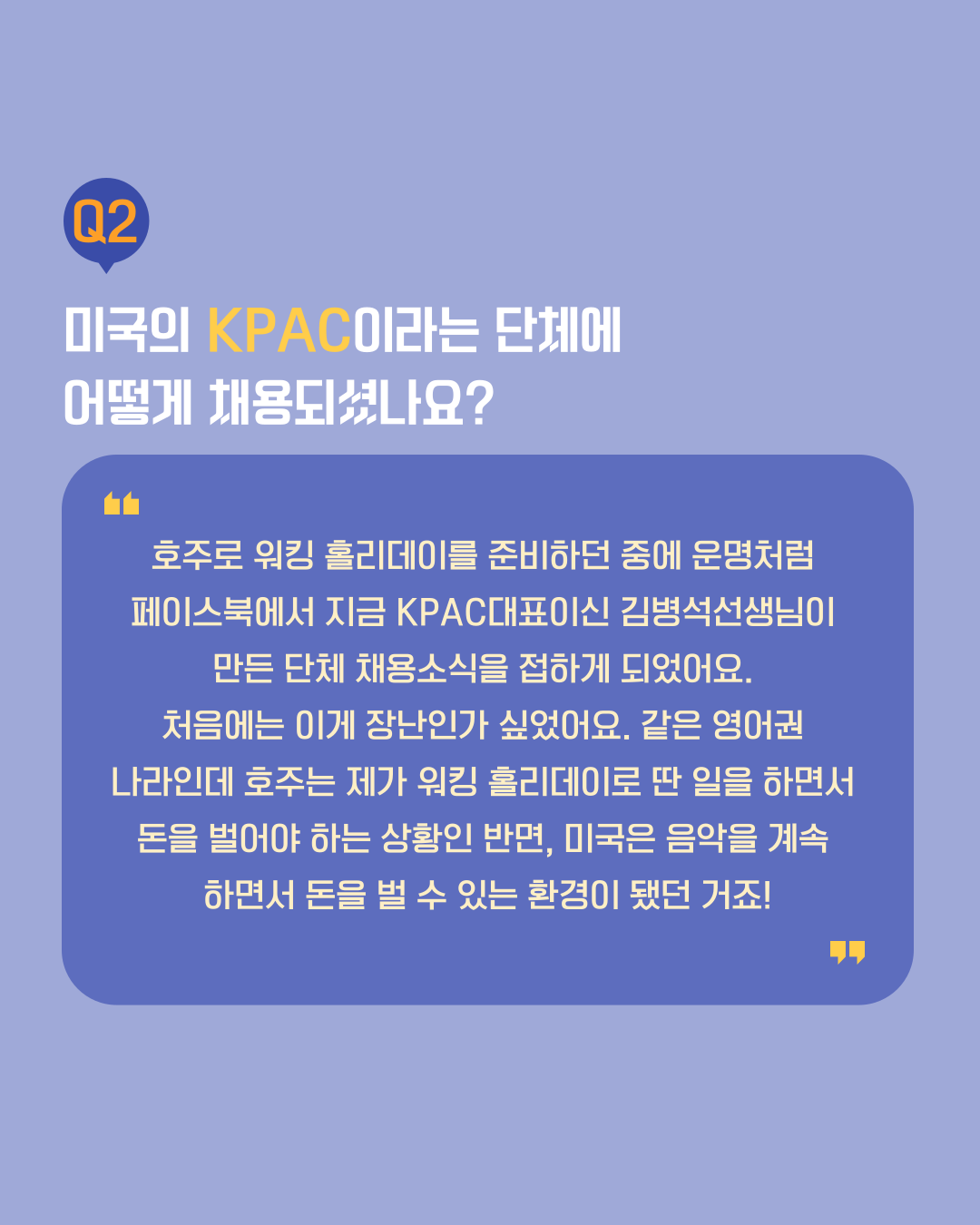
Around 2013–2014, I was actually making preparations to study in Australia. Tuition was very expensive, so I planned to go on a working holiday visa first, earn some money, and then start studying. But then, by a twist of fate, I saw on Facebook that the founder of the Korean Performing Arts Institute of Chicago (then called Global Pungmul Institute) Byoung Sug Kim had created a new organization. At first I thought, Is this real? The way I saw it, both Australia and the U.S. are English-speaking countries, but the difference was this: In Australia, I would have to work odd jobs to save money. In the US, I could earn money while continuing to do music. Between the two options, I think Australia would have been more economical.
Hyunchae Kim: Really? I would’ve thought the opposite.
Suwan Choi: No, Australia would have been mostly about working. Work as the main thing, study as the side thing. When I first came to the US, the conditions weren’t very sustainable. But I was set on studying abroad and living overseas, so I chose the US.
Hyunchae Kim: When you decided to study abroad—whether in Australia or the US—what did you want to study?
Suwan Choi: I think I just wanted to study Western music. Simon Barker—the drummer I mentioned earlier—isn’t really a classical drummer; he’s closer to jazz, experimental music, improvisation. I was attracted to that. I had no information about how to study abroad as a Korean traditional musician. The only stories I heard were about people who studied theory abroad, so I didn’t really see a path for myself. Honestly, I wasn’t sure what to do. Because if I went to an American institution, and they said, “Play the drums,” I wouldn’t have been able to. I was really into hand percussion at the time, so if I had gone to Australia, I probably would have studied hand percussion.
Hyunchae Kim: When you came to the US, you came on a work visa. How did you go about looking for programs?
Suwan Choi: The situations in Australia and the US were similar. At first, I wasn’t thinking about studying—I was thinking about earning money. Tuition is so expensive in both countries, and the savings I had in Korea wasn’t enough. I figured I’d work and save up for two or three years, then consider studying. I gave myself time.
Hyunchae Kim: Did you have a target amount in mind for allowing yourself to begin your studies?
Suwan Choi: I didn’t calculate exactly how much I would need, but I just thought $5,000 should be enough to get started. And I thought I’d work some side jobs while attending school, even though it’s technically illegal.
Hyunchae Kim: So did you save up that $5,000 and then enroll in school?
Suwan Choi: No. Things changed once I got here. When I first arrived, my salary was much lower than what I made in Korea, even accounting for the exchange rate. I came to experience living abroad in an English-speaking country, but the reality was tough. I came on a P3 visa (an artist visa), which has to be renewed every year. So I thought, even if I don’t make much money, I can come back to Korea after a year. And I thought there would probably be more opportunities to earn once I got here.
During the first year, I spent up what little savings I had. I threw myself into studying English and meeting people, but my English didn’t improve as much as I had hoped. I realized I wasn’t ready for school, so I kept studying English and stayed longer. As for my salary, even if it increased a bit, it wasn’t going to jump up dramatically. Fortunately, a scholarship opportunity came along.
Hyunchae Kim: How? A school scholarship?
Suwan Choi: Yes. I arrived in 2015. That year, Northern Illinois University (NIU) hosted a symposium called “Teaching World Music,” which happens I think once every 10 years. I went with Director Byoung Sug Kim. I attended a bunch of sessions across two short days, and I felt a spark—What if I studied this? Everyone spoke English and I had to strain myself to understand, but presenters were met with questions and warm laughter. I thought, People who talk about music education can get this kind of enjoyment out of it. It must be so rewarding. It was exciting, and I thought it would be even more exciting if I could be the one standing up there and speaking someday.
After that, my desire to study grew stronger. At NIU, I met Professor Jui-Ching Wang, who oversees the entire World Music program. Because Director Kim and I belonged to GPI (Global Pungmul Institute), a Korean music organization based in the Chicago, IL area, and because Korean music falls under the scope of World Music, it was a natural match. I told her I was interested in pursuing graduate studies, and she gave me a lot of guidance. After several meetings, I began to make preparations to attend school. In 2015, I felt that going to school could be a real possibility. Then, I began preparing for the TOEFL and eventually enrolled at NIU in 2018.
Hyunchae Kim: So the scholarship you mentioned—did you receive it through Professor Wang’s recommendation?
Suwan Choi: Yes. Tuition was fully covered, but I had to pay registration fees and course credits. From what I remember, tuition at NIU is around $5,000–$8,000 per semester depending on how many credits you take, and the additional fees were around $2,000.
Hyunchae Kim: Then you only paid $2,000 per semester?
Suwan Choi: Yes, but that was the domestic rate, not international. International rates are much higher. I got my green card right as I enrolled. I initially enrolled as an international student but later switched to domestic.
Hyunchae Kim: How much more expensive is the international rate?
Suwan Choi: For undergrads, I think it’s about $20,000 total. Tuition and fees alone are probably about $15,000, but if you add housing and living expenses, probably closer to $30,000 a year.
Hyunchae Kim: Did you ever consider other schools?
Suwan Choi: I did. I would advise other people looking to study abroad to choose a school with a Korean professor who studies Korean music. I think that’s probably the fastest way to progress your studies.
Hyunchae Kim: Are there schools like that? Korean professors who study Korean music must be few and far between.
Suwan Choi: There’s Professor Donna Kwon at the University of Kentucky and Professor Nathan in Canada.
Hyunchae Kim: Why do you think it’s better to go to a school with a Korean music professor?
Suwan Choi: As a Korean traditional musician, if you want to study abroad using your own instrument or music, you need to make the most of that skill. But if you end up somewhere where nobody understands your instrument, it’ll just end with curiosity. “What’s that instrument? It’s from Korea? What is it made of?” That’s usually where it ends. But if a professor is already familiar with your instrument or music, you can actually utilize and build on your specialty, get more mileage. For example, there was a person who specialized in sori who was studying at the University of Kentucky. She was very active in her area while she attended school. And the professor there researches pungmul, so she also participated in the Korean drumming ensemble. I think it’s a good strategy to work with someone who knows your music, its idiosyncrasies and practical applications. If you’re at a place that has no idea, you have to do a lot alone.
Hyunchae Kim: You graduated from NIU, and now you actually teach there. It seems like NIU was a good connection to build from. Was that process difficult? It sounds like there might be some regrets.
Suwan Choi: Not exactly difficult, but not easy either. After I entered in 2018, I realized I needed to find my niche. At this American university, or at conferences, in the American music scene in general, what should I focus on to do better? As a performer, it was impossible to beat others in English. So what could I excel at? My music. So I proposed starting a Korean percussion ensemble class or starting a group at the school. I taught extensively in Korea, so even though the language barrier was a challenge, I thought teaching a class would be doable. But for various reasons, it didn’t work out then.
Later, I realized it was due to a misunderstanding between the professor and me. Long story short, I said, “I can do this,” and the professor said, “Okay,” and, well… that was it. (laughs) I thought if I had told her I could offer this thing, she would handle scheduling, reserve a classroom, because I didn’t know how to go about these things. But she assumed because I only brought it up that one time never followed up, that I didn’t actually want to do it. So both of us thought the other wasn’t interested. That was a lesson in cultural difference… (laughs).
Hyunchae Kim: Right, how you communicate. We talk about that a lot here. You have to be proactive and set the stage yourself because no one will do it for you. Was it that sort of difference?
Suwan Choi: Exactly. The professor later told me when discussing work, I should lay things out from A to Z, 1 to 10. She said making a detailed proposal is the beginning of a good conversation. Not just “I can do it,” but in my case, specifics around who, what, when, where, why, and how I was intending to carry out such a class. Only then can the other person respond with what’s possible or not. Since then, I try to ask very clear yes-or-no questions when working in English. For example, one of my current responsibilities is handling incoming performance inquiries. Instead of just saying, “Yes, we can do it,” I say, “We can do A, which will lead to outcome B. Does that sound good?”
Hyunchae Kim: So indicate what you can do versus what you can’t do, and explain what is possible in detail so that the conversation could progress further, right? Here’s another thing I’ve noticed. In Korea, people don’t really email, they discuss things in person and then send pertinent documents by email afterwards. But in the US, they do everything by email, so to get something done, dozens of emails have to be sent back and forth. It’s something I’ve been learning, too, but the work seems to go more smoothly when the email correspondences are tight.
Suwan Choi: That’s right. The back and forth emails are very important.
Hyunchae Kim: The speed of email response is important, too. If a few days go by without a reply or the reply is really short, you feel like maybe this person isn’t interested. But I’ve seen a lot of cases where Korean musicians visiting to perform in the US are asked, “Did you check your email?” and they say, “I don’t really check my email.” Korean emails can be full of emoticons and small talk, or cold like official documents. Emails are used differently in the US, so I think being aware of that difference can be helpful. Europe, as well. A lot of the work you do at KPAC is through email. When I see that, I feel like you spend a significant amount of time reading and answering emails, but could you talk about some of your other responsibilities as an Artistic Director?
Suwan Choi: Sure. I returned to KPAC after graduating in 2021. As the organization grew, our roles needed to be defined more clearly, so I became the Artistic Director. It sounds grandiose, and I didn’t know if I could live up to that title, but my work is not so much making major artistic decisions on behalf of the organization as it is managing performances, which entails communicating with clients, coordinating on-site, introducing myself to organizers, and making sure the stage is setup. My main job is basically to make sure performances go smoothly. So I’ve gone to many performances, but something I’ve noticed is that even though the US is a major power, performance conditions are often pretty poor.
Hyunchae Kim: Compared to Korea?
Suwan Choi: Yes. For example, in Korea, let’s say you go to the Cheongyang Red Pepper Festival, which I’ve actually been to a few times. At an event like that, the performance area is always set up pretty well. Speakers and other sound equipment are all on stage, and the audience seating is laid out nicely. I thought that kind of setup that you see in Korea was a given because I grew up there. But in the US, the conditions tend to be either excellent or terrible.
We’ve performed in a parking lot, right next to the cars without anything—no chairs, no mics. We’ve performed at a park on the grass where there’s a clearing for a performance area. Someone has brought their bluetooth speaker and emceed from a karaoke mic. Then on the other end, there’s an organization called the NCTA (National Council for the Traditional Arts) which hosts a bunch of folk festivals every year, and their infrastructure is pretty set. They invite local vendors and artists from all over, they create different areas within the festival grounds, and they spread the performances out across different stages. So a major festival like that has pretty well-established infrastructure. They have food vendors, outdoor stages, sound equipment, artist changing and waiting rooms. Everything is pretty well set up.
Because performance conditions can vary so much, we try to discuss everything beforehand via email. Even when we’ve communicated and gotten the OK on 90% of our performance needs beforehand, sometimes the setup we requested has been completely overlooked. Sometimes everything will have been settled, but the setup will be completely different from what was discussed. It’s very unpredictable. If you’re not working with a large organization, keeping up with those communications can be exhausting, but now I’m used to it, so I can make calls and judgments as I go.
Hyunchae Kim: Working with you, it seems like a big part of your job is risk management. (laughs) You go to a lot of new places, and the conditions are often great or awful compared to Korea. Sometimes the situation is something you could not have imagined, so you have to respond on the fly, but the show must go on. That’s a huge risk, and that’s a big part of your job.
Suwan Choi: I think you’re right. (laughs)
Hyunchae Kim: It requires know-how and communication skills, so your role is essential. The things that we took for granted in Korea might not be guaranteed here, so sometimes I feel like we’ve been downgraded. (laughs)
Suwan Choi: I have a lot to say about that. I think it also applies to the music. When I first arrived, reality hit. I felt a lot of shame. My pride and self-esteem took a deep dive with regards to my music. For example, the students I taught when I first arrived in the US sometimes would come across performance opportunities, and I had to perform with them. Of course, these students worked really hard, but a professional player and elementary school students are on completely different levels. So to play with them, I had to bring myself down to their level. That’s the simplest solution. But these kinds of situations where I had to downgrade myself were really common. There were no other professional samulnori players I could play with here. I did more student performances than professional performances. Once, during a performance, the audience was laughing and I was smiling too, but inside I was thinking, What am I doing here?
And there’s the matter of performance fees for artists. Top mainstream American artists like Lady Gaga and Billy Eilish make a huge sums of money off of just one performance. But that’s the big time. In the minor market—which includes Korean music—it’s different. My first performance fee was unbelievable. I made $30. (laughs) But I did so many performances for free, I was grateful to be paid $30. I want to say money isn’t everything, but the truth is that it is very important because we have to make our living off of our music and performances. In Korea, guest performances and small gigs are an important source of supplemental income, even if you have a separate main income. You come to the states and perform your heart out, you get paid maybe half or even 1/10th what you would get paid in Korea. And that’s fine, but to be paid so little is psychologically damaging. When you get paid $30 for a gig, you start thinking, I can’t do music anymore. If you get paid $30, $50, $20, $100 for performances, performing 2 or 3 times a week is not enough to make a sustainable monthly income. In fact, performing ends up costing more than what you get paid. Then you start thinking about how you can make additional income, and you feel even more downgraded. You think, music doesn’t have to be my priority.
I also realized that being a full-time musician in the US is rare compared to Korea. Early on, I met and collaborated with a saxophonist, a drummer, and a few guitarists. I had classes in the afternoon, so we generally met in the mornings. I would say, Let’s rehearse together. How’s 10am? They would say, I can’t, I have work then. I used to think that this other “work” was music-related, but I learned later that it wasn’t. They had to work in offices, as theater admin. That’s when I learned that most musicians also have day jobs. They work 9 to 5 somewhere and do music after. That was another wake-up call. I thought to myself, I practice music all day. How could their output be the same? Should I really be rehearsing and creating music with these people? At least before Covid, most Korean traditional musicians in Korea were full-time artists, so the idea of working a second job was completely foreign to me. Because that had been my experience, I felt discouraged by this apparent difference in commitment. From my perspective, this person might be passionate and hard-working, but I couldn’t help but feel that their efforts were not as earnest as mine. I could devote all of my time to music, so rehearsing together seemed kind of meaningless. I practiced so much, but I felt like I had to bring myself down to the level of someone who only practiced so much.
On the other hand, when I did rehearse with these people, it was very intensive. Something that would take two hours in Korea might be accomplished in 30 minutes with intense focus and energy. But these downgrades I felt in my musical activities often shook me psychologically. It gave me a lot to think about. Maybe I’ve been Americanized, but I’ve become used to it and now, I just go with the flow. It’s like the saying: “The river is the river, the mountain is the mountain.” (laughs) I’ve learned to accept things as they are.
Hyunchae Kim: Last question. If a Korean musician came to the US to pursue music today, what advice would you give them?
Suwan Choi: Bring a lot of money. (laughs) Just kidding. Don’t be afraid. Of course, no matter how long you’re in the States, anyone who comes over is forced to leave something behind in Korea. The more attached you are to what you left behind, the harder life here will be. And people worry about how safe the US is. Chicago, especially, has a reputation for shootings. But I’ve never seen a gun or a bullet in my ten years here. Chicago is that safe. Don’t worry about the things people who have never even lived in the US might say. Come and experience what life in the US is actually like without being afraid.
Hyunchae Kim: I agree. I think we’re all fearless here. (laughs) Let’s say you just arrived in the US today. What would you do first?
Suwan Choi: I think I would use ChatGPT as much as possible. I would search for restaurants and activities in my area. And I can do that from home, but if I wanted to go out, I would definitely go to a lot of music venues. I would see more shows. I think American venues have a different vibe, which I like. The vibe of a Korean venue might be like that of the Cheongyang Red Pepper Festival, which I mentioned earlier, with elderly men and women dancing while sporting sun visors and waving fans on a hot day. In the US, every venue is very different. When I look around the space, I feel like I also often get musical inspiration. So I think I’d go to a lot of shows without discriminating between genres.
Hyunchae Kim Early on, you invested a lot of time and energy into learning English. Any tips?
Suwan Choi: Don’t study conversational English. Study for a test—TOEIC, TOEFL, IELTS. I think preparing for those exams improves your English much more. And I feel like memorizing vocabulary is more effective than learning conversation. I want to say something about how people approach English. I don’t speak perfect English, but it’s not uncomfortable for me. But when I use English, I think of it as a tool. English I use at a restaurant, English I use at a performance site, English I use at a movie theater, English I use at school. Each situation requires a certain kind of English, so I think you just need to know the English for that situation. In other words, forget being fluent. Think to yourself, I am a foreigner using English. Then I think what you need to learn becomes pretty clear. But perfect pronunciation, perfect grammar, perfect intonation—If you focus on these things, it’s going to be really hard for you to speak. If you plan on studying abroad, I recommend preparing for an exam.
Hyunchae Kim graduated from the Department of Korean Music at Seoul National University with a Doctor of Musical Arts (DMA), formerly served as a lecturer in the Department of Korean Music at Seoul National University, and is currently an Artist in Residence at the Korean Performing Arts Institute of Chicago (KPAC). She is also the Founding Director of Stringway.
Suwan Choi graduated from the Department of Traditional Performing Arts at Wonkwang Digital University. He is the former performance team leader of the traditional performance group Nanjang & Pan, and former member of the Cheonan City Heungtaryeong Pungmul Ensemble and Cheongju City Orchestra, earned a Master’s in Music Education from the Department of World Music at Northern Illinois University, and is currently the Artistic Director at the Korean Performing Arts Institute of Chicago (KPAC).
